You arrived on earth without clutter. Your parents and doting relatives started you on a pathway to accumulation. By the time you were a year old, you had mounds of functional clothing, twenty outfits suitable for dress-up, too many stuffed animals to fit in your bed, custom-sized furniture, a silver spoon, and a plastic Winnie-the-Pooh bowl. Perhaps there was also your christening gown: an heirloom already packed safely away waiting for the next generation. You had not even become a toddler yet, and you had already embarked on the road to the clutter trap.
Perhaps your most treasured possession during this time was a favorite “blankie.” This was one item that just made you feel good when you dragged it everywhere you went. You also had a rattle that served two valuable functions. It made noise, and it was handy to chew on when your gums hurt. And the most attractive item in your crib area was that mobile of the shiny fish that swam above your head. Even at this early age, you were surrounded by some things you loved, some things you found useful, and some things you found beautiful.
And there was other “stuff” too. There were broken toys, clothes you were rapidly outgrowing, a quilt someone made that felt scratchy. These were the beginnings of clutter in your life. But were you caught in the clutter trap?
No! You weren’t trapped because you didn’t care. You didn’t interrupt your life’s work (eating, playing, sleeping, and saying “no”) to worry about any of this. Your caretakers worried about them on your behalf.
By the time you became an adult, the story was different. While you were still surrounded by clothing, toys, furniture, and heirlooms, by now you had added two hair dryers, four televisions, three telephones, a computer, a washing machine, a lawnmower, a partridge-in-a-pear tree-decoration and other machinery for life. Friends, family, and colleagues had given you gifts, paintings, china, and things you never used, and didn’t particularly like. But you could never quite decide to get rid of them.
Here Comes the Clutter Trap
Although 50 to 95 percent of your life is operating very well, and you feel successful in most areas, you sometimes:
- Feel overwhelmed when you look at your closet or the garage or attic
- Put off important things because they seem too massive to tackle in your current state of mind
- Avoid having people visit your home or office because it looks too messy
- Tremble at the thought of an audit, because you probably couldn’t find supporting records
- Spend hours looking for your car insurance documents
- Get headaches, neck and back tension, or grind your teeth because you can’t seem to find a place to relax anywhere
- Wonder what is wrong with you that you can’t seem to stay organized
- Consider taking yet another time management course to get it all under control
- Yearn to escape to a desert island.
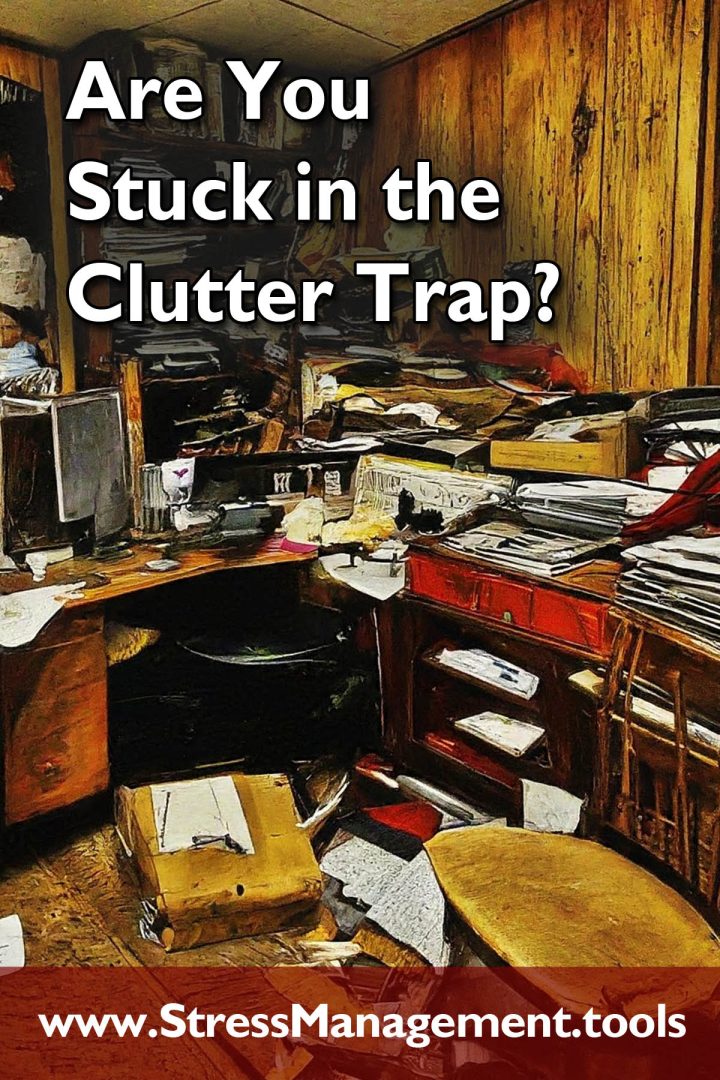
Here’s the simple truth. Everything — everything — you have in your life either nourishes you or drains you. It either supports your dreams and desires or sabotages them. If too much stuff in your immediate environment drains you, you are caught in the Clutter Trap.

The Clutter Trap is a state of cumulative disorder that diminishes your physical, mental, emotional, spiritual, or financial health. It is a dangerous threat to your productivity, your prosperity, and your peace of mind. Underestimate that threat at your own peril.
The Clutter Trap is more than an occasional temporary mess you make while finishing a project or getting dinner ready. It is a multiplicity of messes. It is chronic, cumulative, chaotic, cramping, creeping disorder.
Your Family and Your World Needs Your Best
Suppose you wake up tomorrow with a kindly presence whispering gently in your ear. “You are such a great person, we have decided to give you your heart’s desire of the most ideal setting in which to live and work.” You float half-awake with welcome visions of a sun-drenched easy chair, a penthouse office, a water view, an inviting golf course just outside, cloud-soft carpets, luxurious furniture, relaxing aromas, fragrant flowers, harmonious sounds, peace, calm, and order everywhere around you, and just the right amount of stimulation to keep your juices flowing.

Then you open your eyes–and reality strikes! First, you see the exercise machine draped in yesterday’s gym clothes, then the closet door you hate to open for fear of being smothered by the crushing mass of things stuffed inside, then the stack of newspapers left from last weekend, then the smudge on the wall from some mysterious source, then the carpet that could use vacuuming, and finally the torn-out travel article you read last night, as you imagined a dream vacation away from all this.
“Oh well,” you say to yourself, “I’ll clean up tomorrow. Meanwhile, I’d better brush my teeth and get going. This is a very busy day. The clutter can’t be that important.”
And maybe you are seriously wrong. Maybe the clutter is enormously important. Think back to those waking moments when you imagined the ideal setting for your life and work. Think of how you would feel, act, and respond in such a setting. Would that setting help you feel focused, vigorous, strong, talented, generous, energetic, calm, relaxed, powerful, productive, or peaceful? Then remember how you felt when reality hit. You may have felt overwhelmed, drained, depleted, depressed, or at least discouraged.
Now picture going into your day without the clutter. Which setting inclines you toward your most satisfying results and your most nourishing relationships? How much difference could the right setting make to your ability to focus, to respond fully to all the opportunities of your day, to develop fresh solutions for the challenges you face, to return home and be a more loving partner and parent, to link with your neighbors to create a stronger sense of community?
Very few people are truly impervious to their setting. Most of us just pretend we are. We make promises to ourselves to take care of the clutter later. In the meantime, we walk around as incomplete, diminished versions of the fully resourceful, fully generous people we could be.
And our family and our world need our best. Setting matters. Freedom from clutter is not just a selfish pursuit of our own comfort or convenience. It is not just a luxury that makes our setting “nicer” or “cleaner” or “safer.” That freedom also unlocks us from distraction and distress, so we can connect and contribute more abundantly to our family, our community, our world. As one client said, “Save the planet, starting in my attic!”
Where will you start?
And if you are interested to learn from Barbara how to organize your physical and digital clutter, you can sign up for a free webinar.
Do you need a guide to help you understand how to cope with Stress in an all inclusive approach? Learn how to combat stress, mentally, physically, emotionally and strategically in your life.