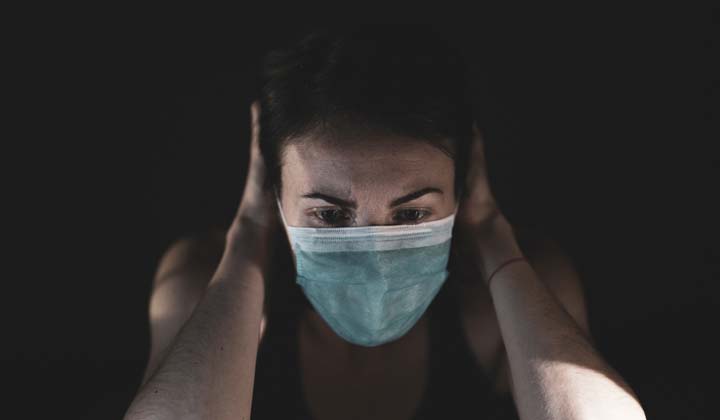
Almost half of the Americans report that the pandemic is affecting their mental health.((Coronavirus is harming the mental health of tens of millions of people in U.S., new poll finds. Washington Post, April 2, 2020)) A federal disaster distress hotline ha seen a more than 10x spike in incoming text messages during the pandemic.((The Health 202: Texts to federal government mental health hotline up roughly 1,000 percent. Washington Post, May 4, 2020)) In the UK a study ascertained the anxiety level of the population on a scale of 1 to 10. They found out that the average anxiety level jumped from 3 before the pandemic to 5.2 right after the lockdown.((Coronavirus and anxiety, Great Britain: 3 April 2020 to 10 May 2020. Office of National Statistics)) Especially couples and elderly people have seen a drastic rise in anxiety level.
The reasons for the steep increase of anxiety and stress are manifold. One of the more obvious ones is fear of getting infected when leaving home. News from relatives or friends who succumbed to the disease will just increase the fear of being the next victim. Although some simple protective measures are healthy, the more anxious ones are getting neurotic in their hygiene attempts. When studies were published that the virus can stay airborne for about 3 hours, this heightened the ill effects of coronaphobia in a large number of people. It is important to put the risk into a healthy perspective, and I wrote an article about the naked truth of the coronavirus that can help in that matter.
Quarantine is another source of stress. Especially those who reported being lonely have felt a greater rise in anxiety levels. As about one-third of the world’s population is put under quarantine, a number of mental health issues like low mood, irritability, stress, insomnia, anxiety, depression and others are on the rise.((Lockdown is the world’s biggest psychological experiment – and we will pay the price. World Economic Forum, April 9, 2020)) Social isolation is a big factor in that, together with feeling trapped at home and interruptions of the usual daily routines.
For families with children, the stress of schooling their children and entertaining them at home puts an extra burden on the parents that they are often not used to handle (We have some tips in the article: 15 Creative & Fun Family Activities You Can Do at Home). In some cases, a dysfunctional relationship is aggravated by the fact that the family is forced to stay together in quarantine, and having no place to escape. Domestic violence is increasing drastically during the lockdown.
Others are even more stressed with the thought of getting back to normal. After returning to work, will there be a risk for a second outbreak? What is my risk of getting infected being in touch with people again? Some risks are for real, but after doing some healthy precautions, put your worries away. And it is alright to take your time and return gradually into social life once the lockdowns are lifted.
Another source of stress is news overload. Some are trying to catch up with all the latest news, and chasing the newest studies to try to understand a disease that even experts have a hard time to understand. Coupled with that are a number of conspiracy theories that are gaining much popularity. One example is a video of Judy Micovits who went viral, claiming that the virus was released from a Chinese lab, and that most information published is just a big scam. Fact-checking revealed that her video was the bigger scam, and most of her statements were simply made up.((Fact-checking Judy Mikovits, the controversial virologist attacking Anthony Fauci in a viral conspiracy video. Science Magazine website, May 8, 2020))
Finding a scapegoat for the pandemic seems to be attractive for many, but it may be just a way of avoiding to take their own responsibility of needing to respond to the crisis. Some others have an urgent desire to find out the truth. Yes, it is very likely that China has underreported their COVID-19 death rates since they do not correlate to the Wuhan crematory activities.((Cremation numbers reveal possible suppression of true COVID-19 data in China. News Medical, June 8, 2020)) On the other hand in the western hemisphere the death rates are more likely to be a bit overreported since financial benefits are associated with the treatment of COVID-19 patients. But finding some proof that the virus was man-made in any way would be a pretty hard task, even in the hypothetical case that it would be the truth. And at the end of the day, what difference will it make for your life?
A much more tangible stressor is the economic impact that the pandemic is causing worldwide. With a large number of people losing their job, financial difficulties are a reality in many homes. There are plenty of families out there just struggling to put food on the table, and that can be stressful.
Health profesionals who are on the frontline of the battlefield are especially vulnerable of suffering from stress during the pandemic. Those who are exposed to patients dying around them every day can suffer from post-traumatic stress disorder.
How to Stay Sane During the Pandemic
Have a Plan
Being prepared can do a lot to minimize the stress you face during this crisis. Preparation will include provisions for maintaining your food supply (stocking some food, maybe considering an own garden to help out), implementing safety precautions, things to do during the pandemic, how to protect your financial interests and more.
Manage your finances

Mishandling your finances is quite easy when you are dealing with economic turmoil all around us. Hence, you need to start managing your finances wisely to avoid having regrets when the problem has passed. When you are on a tight budget, you need to be doing proper financial planning, recording all the expenses and analyzing where you can save. Then you should avoid debt wherever you can. Buy things when you can afford them, paying the full price in cash. Any dept will add extra stress during uncertain times like we are passing now.
Filter Information
Avoid bad news whenever you can. Spending time reading alarming tales of the horrors of COVID-19 will probably increase anxiety, not reduce it. Do not focus on the kind of information that will not help rectify the situation. Pay attention to material that gives advice on how you can overcome or guard against being affected by the worsening of the pandemic. Filtering information can also mean changing the subject when bad news are brought up countless times.
Keep Exercising
As you know, exercising is a great way of staying positive, staying healthy, and improving your overall physical and mental well-being. You may be tempted to cancel your workout routine while the gym is closed or severely restricted. But you can do an exercise routine right at your home, or go out for a walk with all the needed safety precautions. Exercise does a lot to eliminate stress or anxiety from your mind, and keeps your thoughts clear and focused. Therefore, keep exercising and enjoy the process.
Stay Connected with People

While you are not able to meet up with friends and family the way you would like, you need to make an effort to reach out to them. Schedule some regular time to check in with those you care about. It will do a lot to keep your mind sane in a time you are restricted in what you can do. Be especially mindful about the needs of your parents, grandparents or other elderly people around you.
Find some Meaningful Activities
We all have a need to belong and to have a purpose in our life. While you are at home, find some activities that can be meaningful to you and to others. Sometimes caring for someone else is all it takes to take off the focus from yourself and see the needs of somebody else. You may be doing some remote work, so even you are not going to the office you are keeping up with your regular activities. If your job does not allow for remote work, use your chance to educate yourself and be better prepared once the pandemic is over.
Dwell on the Positive
When things are falling apart all around us, it is easy to get caught in a worry round of fears and negative thinking. Are you afraid of getting infected? Remind yourself of all the protective measures you have implemented, and dwell on all the cases that recovered already. You are weary about the restrictions? Think about what you want to do when the lockdown is over. You are worried about the future? What does it help you to get all wrapped up with your worries?
Jesus expressed it right in the Sermon of the Mount: “Therefore I tell you, do not worry about your life, what you will eat or drink, or about your body, what you will wear. Isn’t there more to life than food and more to the body than clothing? Look at the birds in the sky: They do not sow, or reap, or gather into barns, yet your heavenly Father feeds them. Aren’t you more valuable than they are? And which of you by worrying can add even one hour to his life?… So then, do not worry about tomorrow, for tomorrow will worry about itself.” Matthew 6:25-34
It is correct to properly protect yourself. You should do the part that you are able to do. But after having done your part, what does it help you to keep worrying?
Find a Save Haven of Rest
When troubles abound all around you, there seems to be plenty of reason to get worried. But stress will take hold of you if you are feeling that there is a threat to your life that you are not able to control. What you need in this moment is a fortress for your mind to find safety.
A Christian will find this save haven in a meaningful relationship with his Creator. If God was creating you, i He not able to take care of your health? And if he feeds the birds in the sky, is he not going to take care of you? Knowing that we have a Heavenly Father that takes care of us, will provide a fortress to our mind that will resist any storm that may go on around us.
The Bible is giving us lots of examples how our Heavenly Father was taking care of His children in the past. But you need to rest assured that He will do the same thing in your life, if you commit yourself into His care. In order to have this assurance, you need to have a living relationship with Him. You need to take a step of faith and experience for yourself that you can trust your Heavenly Father to take care of you.
Would you like to have this experience? Would you like to discover the promises that your Heavenly Father has given you that He will take care of you? Do you want to discover the purpose that He has for your life? Do you want to know what more your Heavenly Father has prepared just for you? If that is your desire, you should take a guided study of the Bible to discover what your Heavenly Father has to tell you today. Use the chance and get your study guide for free.