Stress Management Tools

Helps You to get Stress under Control

  • Home
  • About
  • Blog
  • The Program
  • Free Offer
  • Contact
You are here: Home / Archives for Planning

Planning

Handling Stress Before It Happens

January 30, 2022 by Martin Neumann

Handling Stress

Stress is something that everyone in the world will experience. Some of us deal with a lot of stress – others, not as much. But one thing that we all have in common is that we all have a reaction to stress.
Handling Stress Before It Happens

When something happens to cause stress, we’ll react in either positive or negative ways. The way that you deal with stress will profoundly affect your health and well-being.

Your reaction to stress on one day can affect you emotionally the next day, and even the day before if you’re bracing for it. Unfortunately, there is no escaping stress and there are varying degrees of stress and causes behind it.

Stress Happens to Everyone

There are no groups of people or any single individuals who can avoid stress. Stress doesn’t fit neatly into any one category like a one-size-fits-all event. There are different levels of stress that will vary, depending on the person who’s dealing with it.

There are also different reasons and different times for stress to occur. You might experience more stress at a certain time of the year than other people do. However, stress does fall under the heading for four basic types.

The types of stress are encounter stress, time stress, situational stress and anticipatory stress. Encounter stress has to do with the relationships in your life. This covers your intimate relationships, your work relationships and even stranger or acquaintance relationships.

The type of life that you have can often determine whether you have a high stress level due to encounter stress. People who work in jobs where there’s a great deal of emotions (such as in a hospice care group) might have a higher rate of encounter stress than other people would normally have.

Giving emotional support to a cancer patient

Time stress can occur when you’re feeling overwhelmed with everything that you have to get done – so you fret that you don’t have enough time. You “what if” that you’re not going to get everything done and your stress level rises.

An example of this would be having to be somewhere for an important meeting that you absolutely can’t miss and things crop up to put you behind. Sometimes people will engage in time stress before there’s even an issue.

This “what if” worry can make them feel anxious and depressed because they worry how it will affect their future. The panic it causes can result in even more stressful situations to occur.

Situational stress is what happens when you’re in a situation that causes immediate stress. An example of this can be a car accident, a child becoming ill or a job loss. In situational stress, it’s the situation that causes the worrying and the emotions that go along with it. This kind of stress can be short or long term.

Anticipatory stress is stress that you get because you’re anticipating something that’s coming your way. This might be having to give a speech or wanting to ask for a raise. It can also be about something that’s not even on the horizon.

It’s a fear that the other shoe is going to drop. This type of stress is the kind that has the most “what if” worry involved with it because it’s focused on things that haven’t even happened – and may never happen!

And when the things that you worried about do come to past, they often don’t look anywhere as frightening or terrible as what you thought they’d be. Often we discover that it was not really worth our worries.

Worrying About Stressful Situations Affects Your Health

Thinking about a problem or wondering what’s going to happen isn’t the same thing as worrying about it. When it crosses the line is when you begin to “what if.” You might “what if” about an event, a person or an unknown future.

Plenty of people will “what if” in their mind. Unfortunately, most of them create all sorts of “what ifs” that have a negative aspect to the thoughts. From that negative “what if” can spring a ton of stress that can turn into long term stress if the habit isn’t broken.

Worrying about future events

There’s nothing wrong with thinking “what if” when you’re trying to brainstorm and come up with a purpose or a plan to deal with stress. But if you do random “what ifs” where you let your mind wonder from one bad possibility to the next, this is futile and can even be bad for your health.

This kind of “what iffing” is a stagnant process that doesn’t get you anywhere. It’s like sitting in a rocking chair moving back and forth and expecting to get from point A to point B.

This negative “what iffing” doesn’t help anything and all you gain is fear and a sense of foreboding about the situation or your future. When you engage in unproductive, negative “what ifs,” you can start to experience a host of various health problems.

You can develop headaches or stomachaches. You might start to encounter muscle problems. Worrying about stress is bad for your heart health. When you worry about stress, studies have shown that this habit is known to cause high blood pressure, tachycardia and shortness of breath.

Worrying about stress can even cause heart disease. The reason that it can do this is because when you worry about stressful situations, your body gets an influx of stress hormones.

Having a regular dose of stress hormones puts additional pressure on your heart because of the high blood pressure that goes hand in hand with raised stress hormones.

Besides affecting your body’s health in a myriad of ways, worrying about stress affects your emotional health and your mental health, too. If you worry about stressful situations to the point that it becomes an ongoing habit, you can be at risk of having a mental breakdown.

This usually happens when thinking about and dealing with stress reaches the point where a person simply can’t deal with it any longer. When that happens, he or she can lose the ability to go about their day as they normally would.

It’s an abnormal response to stress that’s linked with worrying about stressful situations and feeling like there’s no relief for the stress in sight. When worrying about stressful situations reaches the point where someone is having trouble eating and begins to deal with insomnia, that’s the point where something must be done immediately to alleviate the worry.

The 4 Types of Pre-Meditated Stress Analysis

People cope with stress in different ways. These coping mechanisms can be labeled four different ways. The first one is problem analysis. With this type of coping mechanism, people think about the problem.

This way of thinking usually means the person is using “what if” in a positive way. They’re not simply turning the problem or situation over and over in their minds. They’re looking for how they can define exactly what the problem is.

Analyzing a problem on paper

This is the first step that often motivates people to reaching for a solution to the problem. When someone engages in problem analysis, they can see the problem objectively without internalizing it to the point that they dwell on it long term.

This kind of coping mechanism is highly effective and doesn’t lead to emotional or physical problems that can happen with dwelling on a stressful situation. The type of people who use this method are the type that are able to separate their lives and self-worth from the problem.

They can look at something that needs to be solved and then lay it down without it causing them to lose sleep. The second type of coping mechanism is plan rehearsal. Someone who copes this way is usually an analytical thinker.

He or she won’t dwell on negative “what ifs.” Instead, this person will think about what he can do to bring the situation to a resolution. Someone using this coping mechanism rarely thinks that there isn’t a solution to a situation regardless of what the problem is.

The person who deals with stressful situations this way usually comes up with several solutions and analyzes each one for the best outcome. People who use plan rehearsal don’t usually carry a stressful situation over into the next day emotionally.

Stagnant deliberation is one of the poorer methods that people use when dealing with stress. This is the type of person who will “what if” and think about the problem, but won’t get anywhere.

They don’t come up with a solution and so they don’t move forward. With stagnant deliberation your emotional and physical health can be affected to the point that it can make you ill.

The fourth coping mechanism is outcome fantasy. With this way of dealing with stress, people fantasize or daydream that they won’t have to deal with the problem because it will be somehow magically solved. This coping mechanism can affect emotional and physical health as well.

It’s rare that a person always uses just one type of coping mechanism. You can use a mixture of all of them but the type of people who use problem analysis and plan rehearsal don’t get stuck in the “what if” or the negative thinking about stressful situations. They might pause there, but they don’t get stuck.

How to Make an Action Plan Ahead of Time to Handle Stress

By knowing how to act rather than react to stress, you can handle stress before it becomes an issue. In every situation that happens, prioritize it. Ask yourself if the situation is yours to handle.

Too many of us deal with things that we don’t have to deal with. We take on other people’s stress. We handle things for friends, a spouse and coworkers that we shouldn’t take on.

It can be tempting to want to help and to want to fix someone else’s stress, but that’s a way to quickly become overwhelmed and stressed yourself!

Take action steps to handle stress before it happens by identifying where you feel the pressure start to build. If you know that you’re going to be pressed for time, then look at what has to be done.

Use to-do lists and pare it down to only the necessities to get you through that day or week. Let go of things that don’t matter in the long run for your health or happiness. Give yourself extra time to accomplish tasks and learn to say no to things – and people – that will eat up time to the point you know it will cause stress to begin.

Don’t focus on the things that you can’t control. For example, if you have a joint project with a colleague and you’re ready with your part, but he isn’t, don’t focus on what he didn’t do.

All you’re responsible for is what you were supposed to do. Let that person suffer the consequences rather than you suffering the stress. When you know that a situation is coming up that has the potential to turn stressful, take the time to write out a list of possible solutions.

For example if you’ve heard that your company is going to be laying people off, instead of worrying about it, write down all of the steps that you’ll take if it does happen. Once you do that, let it go. You’re prepared!

Don’t give in to negative “what if” thinking. You don’t want to attempt to cross bridges before you even come to them. You might find that the bridge never even appears in your life and you don’t want to waste time needlessly.

Do you need a guide to help you understand how to cope with Stress in an all inclusive approach? Learn how to combat stress, mentally, physically, emotionally and strategically in your life.


Get Me the Guide

Filed Under: Planning, Psychology, Thought Patterns

How to Deal With Your Inner Stress

October 10, 2021 by Martin Neumann

How to deal with inner stress

Somewhere on the way to the rest of your life, you realize that things aren’t going as planned.  You might suffer from money woes or realize your marriage is in turmoil.  It’s the kind of thing that makes you sit up and take notice – and seek help before it gets the best of you.

How to Deal With Your Inner Stress

Some things you can work on making better.  If you need to stop spending money, you can develop a savings plan.  But some stress is derived form the inside-out.  It’s the kind of anxiety you have about who you are as a person compared to who you always hoped you’d be.

As time passes, you’ll be facing your fair share of obstacles.  You may have to repair relationships, tweak your career, or learn some new coping skills to help you deal with being a parent.

But if you take this step first – the step to becoming the kind of person you want to be – it’ll make facing those stress factors a whole lot easier.  In fact, when you devote time to making your own self better, many of the things you’re stressed about now will dissipate. 

You don’t need an expensive therapist or rock climbing with an encounter group. You aren’t in denial about what’s bothering you. You just need a little help analyzing yourself and taking action to become a new you. 

Becoming Your Best Self

The Army is right with their slogan, “be all you can be.” Of course, you don’t have to go to boot camp to make that happen. You can create a self-care boot camp at home, which is gentler than the soldier’s version.

One aspect of boot camp that you want to copy is the intense personal training regimen, which focuses on building a better you.

Daydream on Paper

Take a page of lined notebook paper and fold it in half. Using the right side only, write a description of your ideal self. Don’t stop to be critical or analyze anything you write.

Be specific. Instead of saying, “I would weigh less,” say, “I would weigh 30 pounds less.”  Rather than, “I would have a better job,” say, “I would like to manage the sales department.”

Making a self description in a notebook

When you’ve listed everything possible on the Ideal Self side, turn to the left side and title it, Real Self. Again, without being critical, describe who you are today. What is your career?  Where do you live?  What motivates you to keep going every day? Describe yourself physically and emotionally.

Then open both sides and compare. With a bold pen or highlighter, draw lines between the items that are similar as if you were playing a matching game. Then look seriously at how far your Real Self is from your Ideal Self.

In some instances, the distance between Real and Ideal isn’t very far. In others, it’s a big stretch.  Choose two Real/Ideal comparisons as your self-help priorities. Save the list for later.

After completing one transformation, you can choose another goal. These priorities become self-improvement goals. You may be able to learn a new computer skill in a few weeks by attending a class because that skill will be important to earn a promotion to get a career that will provide less stress for you in life.

Losing weight takes more time. What’s important is that you have a goal and can plot a direction. Before you know it, your Real Self comes closer to your Ideal Self.  As you become the person you always wanted to be, you won’t have the stress of being dissatisfied with how your life’s unfolding.

Make a Future Timeline

Timelines are a great way to look back over your life and your career. Start by making a timeline of your personal life or career life, whichever is most pressing for you now and whichever causes more stress in your life.

One way to really see where you came from is to make the timeline on a poster board and add photos or other graphic images that reflect the events. You might be surprised as you recall strengths and abilities that you forgot you had from past experiences.

A picture timeline with major life accomplishments

Get another poster board and create a future timeline. Here’s where you plan the life you want – the life that provides deep satisfaction instead of extreme stress. Mark increments on the line for one to five years, then in five-year increments. 

Go ahead and dream. If money wasn’t an obstacle, what kind of career would you have in five years?  If the funds were magically available for you to return to college or graduate school, what would you study? What degree would you earn? What job would you have after earning that degree?

Once finished, set up the past timeline on the left and the future timeline on the right. Prop them up against a wall in your home where you can just look at them for a week.

As you mull over these ideas, you’ll find yourself focusing on a few areas over and over. Maybe one day you realize, “Hey, this is really what you want, so go for it!”

Save your future timeline and mark off the changes you choose to make in your life. In five years, you may be where you projected or even beyond that point. As long as you focus on being your best self and reaching your goals, you’ll make some progress in your future timeline. And if you are better aligned with the purpose for your life, then inner conflicts and stress because of your dissatisfaction with life will fade away.

Improving Your Body

When you’re trying to lessen the stress you feel, it’s important for your body to be able to help your mind relax.  Our modern lifestyles are so busy and crowded that fitness often takes a back seat to everything else on the daily to-do list. 

If nothing else will bolster your goal to exercise, think of it as the best all-natural stress reliever, which it is!  You may be used to working forty hours plus overtime – then rushing home to cook dinner and, if you have children, driving them to sports and activities.

A ten-minute uninterrupted shower may be the only relaxation time you get in a day before falling exhausted into the bed at night.

1. Take an honest look at your fitness

Most gyms are glad to give you a free week or month to try it out. During that trial period, ask for a fitness evaluation. Are you winded after ten minutes on the treadmill?

A man exercising on a treadmill - Photo by William Choquette from Pexels

Did the calipers measure more body fat than you realized was there?  Are you stretched to the limit with work but unable to do muscle relaxing stretches?  Another fast-track approach to fitness is to hire a personal trainer for a series of personal workouts.  Once you learn which exercises are right for your fitness goals and practice the right way to do those exercises, you can work out on your own.

2. Curb harmful habits

If you think that going outside to smoke or chugging cans of highly caffeinated drinks are ways to deal with stress, you’re fooling yourself. These are likely to create more health problems and more stress.

Take an honest look at the ways you cope with stress. Smoking, drinking, drugs, caffeine and food binges are reckless choices with long-term health consequences. You’re setting out to reach new goals and dreams and you need to be in prime health to enjoy those positive life changes.

Start with learning all you can about your harmful coping method. Knowledge is power. While researching, look for local support groups. If you can’t find one, join an online support group. Your closest Seventh-day Adventist Church may be able to help you with materials or supportive courses for smoking cessation.

For some complex issues, self-help begins when you admit that you need help and seek others who can support your changes.  An important way to avoid negative coping methods is to nourish and train your body for optimal health. 

Improving Your Mental Outlook

The most physically fit body goes nowhere if your mental outlook is bleak. You have to believe in yourself to turn your goals into new realities. Even positive people are hit with difficulties that are hard to manage. That’s when you need stress busting approaches to bolster your mood.

Face your fears

Do your hands get clammy, your throat dry and your mind take you back to your worst day in sixth grade each time you have to speak in front of a group?  You might suffer from stress surrounding certain events.

People at work or in the civic group want to hear what you have to say. Sign up for a local Toastmasters group and take the first step to conquer your fear of public speaking.

A public speaking appointment - Photo by mentatdgt from Pexels

Did you turn down a great job because the office was on the 25th floor and you’re scared to ride elevators in tall buildings?  Climbing the stairs daily might be good for your legs, but it takes time and just isn’t practical.

You can work with a therapist to face this fear and get over irrational stress. Or you can do your own version of “systematic desensitization.”  That’s a therapy technique in which you gradually face a fear a little bit at time until you finally overcome it. 

Ask a trusted friend to go with you as you work on this.  Think about what the real fear is – that you’ll get stuck or that it will plummet to the ground floor when the cable suddenly snaps?

You’re feeling what you expected to feel based on past experience.  Once you have your “fear-feeling pattern” worked out, you know what to expect. Ask your friend to ride with you in an elevator to the second floor then back down again.

Repeat that trip. Then go up to the fourth floor. If you’re seriously in a stress-filled panic, take the stairs back down. Or if riding down is easier than riding up, start by walking to the fourth floor and riding down.

Little by little, increase your ability to handle the stress by pushing yourself a little farther each time.  You can conquer your fears when you name them, examine them, research them and set a plan to meet them.  Over time, you’ll notice your stress level doesn’t rise as high when you’re faced with this particular obstacle.

Learn to forgive

Sometimes we carry our baggage that makes us all emotionally wrapped up with something that has happened in the past. We cannot change what has happened, but we can choose to change our attitude towards the people who were involved in it. If you keep anger and bitterness in your heart, it is like drinking a poison, and expecting that the other person will die from it. You will do yourself a favor if you learn how to forgive, to let things go.

Forgiveness - Photo by Ketut Subiyanto from Pexels

Forgiveness does not always mean that things will be just as before, it does not always mean that you need to reconcile a broken relationship. But what you need is to let go of the feelings of resentment, the angry emotions that eat you up from within, just let it go! Do not allow yourself to continue to suffer about the things that happened to you in the past.

You may say that you are unable to forgive somebody, since they did something terrible to you. If you have no force to do it on your own, pray to God that he is giving you strength. Look to Jesus at the moment they were nailing him at the cross. He was able to say to his prosecutors: “Father, forgive them, for they don’t know what they are doing.” He can give you the force to do the same. Do whatever is needed to get over the feelings of anger and resentment, in order to experience the liberating power that forgiveness can give to you.

Conclusion

Improvements in our lives involve change. We may dread these changes first, but after we see the improvements, we are glad that we did it. Sometimes we need to step back and analyze the changes necessary in order to get us on the right track. When we are wrapped up in our stress, we often get short-sighted and do not see the obvious changes we need to make to resolve the obstacles that are in our way.

Take courage, see what you need to change in your goals, your health habits and your mental outlook of your life. Never settle for a life filled with stress when there’s something better waiting for you.

When you working on improving yourself, you will probably come closer to the purpose that was given to you in this world by your Creator. And when you know you are fulfilling not only your goals, but also your purpose, you will feel a satisfaction that will help a lot to melt your stress away.

Do you need a guide to help you understand how to cope with Stress in an all inclusive approach? Learn how to combat stress, mentally, physically, emotionally and strategically in your life.

Get Me the Guide

Filed Under: Goal Setting, Healthy Lifestyle, Planning, Self Help, Stress Management

Are You Stressed Out about Having no Time?

August 14, 2021 by Martin Neumann

Are You Stressed Out About Having No Time?

You surely heard the phrase: Time is Money. We may agree, but in practical terms, are you one of those people who turn around any penny you spend, but you do not think much about how you are spending your time? Do you try to do everything at the same time, but at the end you are frustrated that there are not enough hours in the day, and you catch yourself saying: I have no time? I think it is on the time to think about budgeting our time.

Are You Stressed Out about Having no Time?

If you are successful, you are able to earn more money, but there is something that not even a millionaire has more than you, and this is time. Everybody has 24 hours a day. Time is a finite resource. If you think about your time, you need to think how you want to invest it the most effective way. Are you smart in investing your money? Now think about the return of investment you will get from your time. Where are you going to invest it the most sensible way? This phrase gets it to the point:

Time is what we want most, but what we use worst.

William Penn

Set Priorities

President Eisenhower had an interesting approach to time management. He organized all his tasks in four quadrants: urgent or not urgent, important or not important. The urgent and important quadrant is the one you should give your priority.

There are some tasks that are important but not urgent, like your continual education for example. They will be coming right next in the priority list, and you should schedule a regular time for them each week, so that you make continual progress on something that will give you a better position in the future.

Now the urgent but not important category, you need to evaluate carefully if they are worth your time. Some tasks you may be able to delegate. Others you may drop from your list. You need to learn to focus on items that make the biggest difference at the end. The list of neither urgent nor not important items, you better store away for a day that you have really nothing else to do, but do not let your mind dwell on them.

I have heard another approach that can be quite interesting as well. You define 2 or 3 projects that you want to work on for this week or the near future. Those are the things that need your full attention at this moment. Then you have 3 or 4 projects that you target as next on the list. You may do a little bit of preparation to get the ball rolling, or you may start to work on them if you have some time left, but they are not your top priority for now. Everything else will go into the Maybe Later list, and you do not need to even think about them. Whatever method you use, you need to have a clear criteria, what is the priority for you to tackle at this exact moment.

Invest your Time Wisely

Think about your time as an investment. You need to think, what investment will give you the best returns. Think about sleep for example. If you sleep the hours you need, you will be energized the next day to tackle the tasks at hand with efficiency. If your cut your corners on sleep, your performance will suffer.

Sleeping man -  Photo by Andrea Piacquadio from Pexels

It is actually a wise move to go to bed early and rise early, in order to start your most important tasks when your mind is fresh in the early morning hours. We know that one hour of sleep before midnight is worth two hours of sleep after midnight. So it is a wise investment to go to bed with the chicken and get the greatest benefit from your sleep time.

Be sure to start your day right. When you wake up, spend some time in the presence with God, so He can give you some insights for the day. You will see that things will flow differently when you are doing that. Be sure to get a good breakfast without any rush, because a substantial meal in the morning will give you the energy you need to start the day right.

Exercise is another time investment that will pay you high dividends. If you put in half an hour of vigorous exercise every day, it will surely safe you an hour or two while you work with more efficiency, plus you will put some time in your savings account, since it can prolong your live for several years. Talk about a wise investment!

Automation can be another investment that can pay you high dividends. Why do you need to tackle your payments every month, when you can automate them? It takes you once to set it up, but then you will never need to think about it again!

Budget Your Time

Like you have a budget for your expenses, you should have a budget on your time. When making a purchase, many people will be out to search for the best deal, instead of reflecting first: Do I really need this?

The same is true for time management. Most people will teach you how you can do your tasks the most effective way in order to save a minute here and get done more in your day. Instead of this, you should look at your schedule fist and reflect if you should not simply stop many of the activities you are doing.

Any commitment you make, think first if it is really worth your investment. What are your fist priorities? Your family? Your friends? Making a difference in your community? And at your work, what can make the biggest impact? Cut out some activities that are not essential and do not contribute to the advancement of your priorities.

Every activity you are planning to do, you need to estimate how much time it will take you. If it is something you have done in the past, you will have a good indicator how long it will take you. If it is something you never did before, you need to break it down in different steps, and estimate every step how long it will take you. Your estimate will be more accurate this way.

After having quantified your time investment, you need to evaluate if it is worth it, the same way you look at a product in the store to think if it is worth that price. Next you need to schedule the time in your calendar. If you do not have the time available, you need to either decline the commitment, or you need to drop off some low priority activities you have already scheduled in your calendar. Doing your proper planning can help to avoid a lot of surprises on the way, and will maximize the impact you can achieve with your limited time.

Price tag for fruits - Photo by Wendy Wei from Pexels

Track your Time

There are many ways you can track your time. Some apps can track your activities you do on the computer. Some people like a Fitbit watch that will track their sleep, their exercise and various other activities during the day. Some do a simple feedback on the end of your day, while others like to use an app to do a more sophisticated evaluations of their time. Tracking style can vary, but you should be conscious on how you are using your time.

It happens so often that we are just quickly looking something up on the internet, and before we realize, we have spent an hour surfing around without any purpose. Multitasking is another thing that was increasing greatly in the digital era. On average we are checking every 6 minutes on emails and instant messaging. That is draining your productivity. You need to get into the habit of being focused on one task, and when you are done, you can have a look whether somebody was writing you on messenger.

According to studies, an internet user is spending on average 2:25 hours a day on social media.((Daily time spent on social networking by internet users worldwide from 2012 to 2020. Statistica)) You add to that almost 3 hours of TV time per day, and you see quickly why we have no time left.((Average daily time spent watching TV in the United States from 2014 to 2023. Statistica))

Start to reflect on your habits. Are the 2 hours of scrolling the infinite feed of Facebook really well spent? And when you watch a video on YouTube, how many suggested videos you end up binge watching afterwards? Is this time really well invested, or are there other activities that would be really worth your time?

Do you have no time to play with your kids? Are you wanting to start a hobby for a long time? You are thinking to learn a new language? You want to learn an instrument that you desired to play since you were a kid? I have just freed you up 5 hours a day to do all of that if you want.

Be Realistic in Your Expectations

It is interesting to see how times have changed. When a hundred years ago, a farmer was plowing a field, it may have taken him a day or two, and another week for planting, but at the end he was looking back at his work and he was satisfied with his accomplishments.

A traditional farmer after plowing the field - Photo by Archie Binamira from Pexels

Nowadays things are going faster. A tractor will plow the field within an hour, and an email can go around the globe within seconds. Things are moving much faster. But with that we have also different expectations. If we have no time, because we have overcommitted ourselves.

Our changed expectations will also show up in our homes. While the farmer’s wife was not worried about the dirty kitchen floor while cooking lunch, our kitchen today needs to be sparkling clean. The house got bigger, consuming more time for cleaning and maintenance, and the yard needs to be perfectly cared as well. Think about this statement:

Life is a disappointment and a weariness to many persons because of the unnecessary labor with which they burden themselves in meeting the claims of custom. Their minds are continually harassed with anxiety as to supplying wants which are the offspring of pride and fashion…

The sweet word “Home” is perverted to mean “something with four walls, filled with elegant furniture and adornments,” while its inmates are on a continual strain to meet the requirements of custom in the different departments of life.((Ellen White, The Adventist Home p. 150))

I think it is time to make some adjustment on our expectations. Not everything needs to be perfect, and normally simpler is better.

Better Done than Perfect

We can roughly divide people in two groups: Maximisers and Satisficers. Maximizers are a tribe of perfectionists. If they buy a new phone, they will study all the available reviews for a week, and try to purchase the very best. And even then, they are still concerned whether they have made the right choice.

A satisficer at the other hand will walk into the store, look for the first phone that looks right, asks the dealer if it does what he is looking for and purchase it on the spot.

When it comes to answer an email, the maximiser will investigate the question he was asked, try to write a lengthy response, rewrite it three times to formulate it better, getting all the punctuation right and sending it out when he thinks it is perfect. The satisficer will simply throw in a quick response, maybe not even write a complete phrase, and hoping that it answers the question he was asked for, because if not, they will ask back anyways.

It is easy to see that the satisficer will get much more done in a shorter time, and he will feel more satisfaction on the end of the day. I guess it is important to find a healthy balance between the two. We need to learn to invest our time where it matters most. If my work can really have an impact, it is worthwhile to invest some more time, but when it comes to writing an email, we better get it over, so we can make time for things that really count. And even on the impactful projects, sometimes it is better to get it out and improve later, then to try to make it perfect and never get done.

Plan Your Week

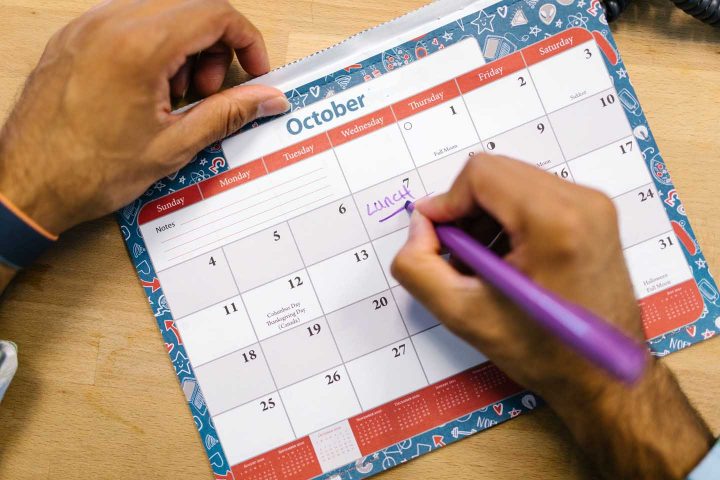
When you are planning your week, you want to look at the bigger picture. You think about maybe 2 or 3 major projects to tackle and schedule their time. You also want to block out some time for essential goals that are not in the urgent category.

A Calendar - Photo by RODNAE Productions from Pexels

Then you look at your last week. You have scheduled anything that was left undone? Next look at the upcoming meetings and commitments that you have scheduled. Are they still your priorities? If not, you can decline or reschedule some of them.

And do not fill up your schedule to the maximum. Some tasks may take you longer than planned, and unexpected surprises are coming up all the time. Maybe keep some time open on Friday to catch up with things you could not get done during the week. This way you can get into the weekend with a satisfaction that you have accomplished your goals.

Daily Planning

When starting out in the morning, you need to spend a few minutes to get on track with your operating plan of the day. Is there anything left undone from the day before? What meetings do you have scheduled? Was there anything new coming up that needs to be treated with urgency? What are your top priorities?

Plans are important, but they are not set in stone, so you need to always recalibrate to reach your goals. But having something sketched out on paper, helps you to be more efficient in order to accomplish your priorities.

Get in Alignment with Your Passions

In a study of more than 3000 working people, researchers found out that those who were passionate about what they were doing, did feel less of a time pressure.((Jachimowicz J et.al. Why Passionate Employees Can Have It All: Passion Lowers Time Stress by Enhancing Goal Integration. https://psyarxiv.com/qd2zf/)) It is not so much about how long the activity takes, but more of how much you enjoy it. A sense of accomplishment did mean that they did not feel that their time was wasted.

A satisfied man - Photo by Jonathan Borba from Pexels

Researchers found also that some people perceived activities as competing for their time. For example, they felt that engaging themselves in the company was conflicting with coming home in time for dinner. Passionate workers on the other hand felt that activities were complementing, since a healthy meal at home with family was giving them more energy for the next day’s work.

Get Divine Wisdom

You have done everything and you are still struggling to make ends meet in your schedule? Is there an emergency coming up and you don’t know how to handle it? James was giving us an interesting counsel many years ago:

If any of you lacks wisdom, let him ask of God, who gives to all liberally and without reproach, and it will be given to him.((The Bible, James 1:5, NKJV))

James 1:5

If you are on a tight spot, you can always turn to God, and He will give you wisdom on how to deal with your situation. So often He is able to show us the right priorities, or what to do to avoid being stressed out about our day. And He has promised to be on your side as your Heavenly Father. Jesus gave us another wonderful promise:

Come to Me, all you who labor and are heavy laden, and I will give you rest. Take My yoke upon you and learn from Me, for I am gentle and lowly in heart, and you will find rest for your souls.((The Bible, Matthew 11:28.29))

Matthew 11:28.29

We do not need to resolve everything on our own. If there is something burdening you, then you can bring it to Jesus and he promised to help you. When you do not know whether you should take up a commitment, have a conversation with Jesus and ask him if he wants you to do this, or pass it on. Understand the purpose that God has for your life. Then you will have a clearer picture on how you can make really the best of every hour that God has given to you.

Do you need a guide to help you understand how to cope with Stress in an all inclusive approach? Learn how to combat stress, mentally, physically, emotionally and strategically in your life.

Get Me the Guide

Filed Under: Planning, Time Management

What are Your Goals for This Year?

January 2, 2021 by Martin Neumann

Reaching Goals

Whenever we enter into a new year, we are reflecting on what we did the last year, and we make some resolutions on what we want to accomplish the coming year. But more often those New Year resolutions are fading away just in a few days as the year is going by. The failure in reaching our goals is just adding to the stress we already have, and it seems like we are going nowhere. How can we avoid that from happening? We need to have a clear plan.

What Are Your Goals For This Year?

Make the exercise for yourself. Take out a sheet of paper and write down what you want to accomplish this coming year. Think about all areas of your life. What do you want to accomplish in your professional life, what in your private life, what in your lifestyle to improve your health, in what way do you want to contribute positively to the society around you, and how do you want to grow in your spiritual life? Write down where you want to be in a year from now.

Now after you have put your thoughts and desires on paper, start to prioritize them. Define one or two top priorities in each area of your life, because you will go nowhere if you focus only on your professional life and leave everything else behind. Also, do not try to do everything on your list at the same time, because you will divide yourself too much and will not accomplish anything in the end.

The Action Plan

Next you need to have a clear plan on how you will accomplish the goals you have in your mind. At this point you need to split up your goals in manageable tasks. What are the steps you need to take to reach your goals?

For example, you may decide that this year you want to write a book. That sounds very much like a daunting task. But if you want to reach it, you need to split it up into different steps. You may come up with a list like this:

  1. Choose the topic
  2. Make some research
  3. Define the chapter structure
  4. Research the material for each chapter
  5. Write each chapter
  6. Revise the content
  7. Proofread
  8. Make the layout
  9. Publish
Writing a manuscript

Having defined the steps, you have already a much clearer plan in your mind on how you can realistically accomplish your goal. Next you need to divide each step into actionable tasks. You can write this out on paper, or you can use a tool like Asana to do that on your computer. Estimate for each task how long it is going to take you. This way you have an objective parameter to track your progress.

Now you put the tasks of the first week onto your calendar. Define how many hours you have every day to dedicate to the task and start out working on it, if possible by tomorrow. You are not going to finish the task in a single day, but every day you are going to make another step that is going to bring you closer to your goal.

Remember that you were putting down a timeframe for each task. There may be moments where you are not finishing the task within the stipulated time. Sometimes you may need some extra time on the following day, because you did not make a good estimate on how long you will take. But wherever you can, try to wrap up your task and get it done. You can always improve your work later on. But often you may find out that you need to resist your temptation to go for perfectionism and just do the best you can within the timeframe you have.

At the end of the week it is time for evaluation. Have a look what you have accomplished this week. Are you within your schedule, or did you take longer than expected? Do you need to adjust your timeframes? Or do you need to improve on your efficiency? Maybe you need to resist your perfectionistic vein and go forward? Make an honest evaluation and adjust what is necessary. Take then some time to plan out the next week.

You also will need to work on your motivation to go forward. This will help you to get new energy when you feel like dragging. Think about the impact the book or any other project you do will have. Think about how it can change the life of so many people around you. This will give you a reason to go forward, because you know it is worthwhile to invest all the effort to get it done.

Making Lifestyle Changes

Not every goal needs to have such a detailed project. But you still need to have a plan for how you will get it done. For example, you may decide that your priority is to manage your stress. You need to know what tools you can use to achieve your goals, and the Ten Minute Guide to Stress Management can give you some hints for that. You need to decide now on which tools you need to focus and make a plan on how you will implement them into your life. And you still need a regular evaluation, maybe weekly, maybe monthly to check on the progress and fine-tune your strategy.

The same principles apply for any other lifestyle change, may it be losing weight, changing your diet or starting an exercise routine. All of those imply significant lifestyle changes and you need to have a clear plan on how to get it done.

When changing your habits, you need to be aware that much of those habits were ingrained in your brain for many years, and it will need a conscious and decided effort to change them. It takes about 30 days to start forming a new habit. During this timeframe, you need to make a conscious decision on every day, until you are forming a new neural pathway in your brain that will turn into a new habit.

Often you will find that you need to build up your motivation to work on your lifestyle changes. Think about the outcome your new habits will bring you. How your health will improve after adopting the new lifestyle? Think about all the things you will be able to do when your health is improving. Without proper motivation, you will often find that your old habits are stronger than your new-year resolutions.

We often underestimate the efforts needed to break loose of an old habit, and you may discover that supernatural power is needed in order to be victorious. But you can ask your Heavenly Father to give you the needed strength. God is telling us:

Behold, I am the Lord, the God of all flesh: is there anything too hard for me?

Jeremiah 32:27

So the next time you are struggling to change your habits, go to your Creator who knows how to resolve the problems on your behalf. The first step you need to take is to recognize that you need help and simply ask for it:

If you then, being evil, know how to give good gifts to your children, how much more will your Father who is in heaven give good things to those who ask Him!

Matthew 7:11

He is just waiting to give us all the help we need to be victorious if we simply go to ask. Imagine a child asking his father for a piece of bread because it is hungry. Which dad is not going to respond to that? And how much more will our Heavenly Father give us help if we ask for it?

A child praying - Photo by Binti Malu from Pexels

After asking our Heavenly Father for strength, we need to act in faith that He is on our side to help us:

Therefore I say to you, whatever things you ask when you pray, believe that you receive them, and you will have them.

Mark 11:24

One time Jesus was meeting a crippled man who was 40 years lame. Jesus simply asked him: Do you want to be healed? But the poor man could think only on all the difficulties in his way. Jesus simply stretches out His hand and says: Stand up!

The man could have thought: You must be joking, I am crippled for 40 years, how do you ask me to stand up? But instead the man acted in faith and made an effort to stand up. In the same moment he was healed and could walk.

You may feel the same way that you are bound into your old habits. But Jesus has promised you to give you the needed strength. After asking for help, simply believe that God is giving you the power to be victorious, and you will see changes in your life that you thought impossible to achieve.

But even then, it is important to to make no provisions to fail. The apostle Paul is telling us:

Put on the Lord Jesus Christ, and make no provision for the flesh, to gratify its desires.

Romans 13:14

If we know that we have a soft spot for sweets, you do not need to pass in front of a candy store, just to see what they have to offer. And if you want to stop smoking, it will be quite tough to resist if you keep cigarettes at home. Whatever your soft spot is, you do not need to make provisions to gratify its desires. You are safer if you avoid temptations wherever you can.

Other Goals

You may discover that real satisfaction comes from a harmonious development of the personal, professional, social and spiritual areas of our life. You need the social network around you, and you need to give some thoughts on what you can do to contribute to the society around you. Helping others without expecting anything in return can be a very satisfying experience for ourselves. And many times the same blessings will be coming back to us when we are in need. Furthermore we are to a large extent social beings. A healthy social network can do a lot to reduce our stress levels.

Social networks can be important in our lives - Photo by Andrea Piacquadio from Pexels

Give some serious thoughts about what you can do to contribute to your marriage relationship, how you relate to your parents, your friends and everybody else around you. Investments are not limited to your professional area only. And normally you will reap according to which plants you put into the ground and how you take care of them.

Give also some serious thought on what is really important in your life. What are the relationships that are really important to you? Do you really value them what they are worth? What else is giving purpose to your life? How do you contribute to society as a whole? You will find real satisfaction when you start to look beyond your own needs and see how you can benefit others around you. The satisfaction that comes from knowing that you have impacted the life of another person cannot be compensated by any money in the world.

Think also about your spiritual realm. Do you believe that there is somebody higher than you in this Universe? Do you trust your Heavenly Father? You have a personal relationship with your Heavenly Father? Many times are we limiting our religious life to a certain creed. But even though our belief system can be important, real spirituality is much more than that. It is a relationship that consists of giving and receiving. Are you willing to invest in your spiritual life? What are you willing to give? What are the values that make your life meaningful?

It was Viktor Frankl who discovered inside the Nazi concentration camps, that those who were surviving were normally those who had a clear reason to live for. After getting out of the cconcentration camps he became the founder of the logotherapy which consists largely in finding meaning in events happening around us.

Knowing our meaning and purpose of life is an important step in forming a healthy worldview. And it can be an important foundation that gives us emotional stability, helping a lot to get stress under control. A well-rounded development of all the areas of our lives can be very beneficial.

So what are your plans? Are you setting any goals for this year? Where do you want to be in a year from now? Are you willing to invest in your goals? What are you waiting for?

Do you need a guide to help you understand how to cope with Stress in an all inclusive approach? Learn how to combat stress, mentally, physically, emotionally and strategically in your life.

Get Me the Guide

Filed Under: Goal Setting, Planning

« Previous Page

Primary Sidebar

Copyright © 2026 Stress Management Tools · Log in