Stress Management Tools

Helps You to get Stress under Control

  • Home
  • About
  • Blog
  • The Program
  • Free Offer
  • Contact
You are here: Home / Blog

Blog

13 Things You Can Do Tonight to Make Tomorrow Morning Less Stressful

March 12, 2023 by Martin Neumann

Are mornings a mad rush at your house? By the time you find matching socks for the kids and answer the text messages that piled up overnight, you may feel like you’ve put in a full day before you even reach the office.
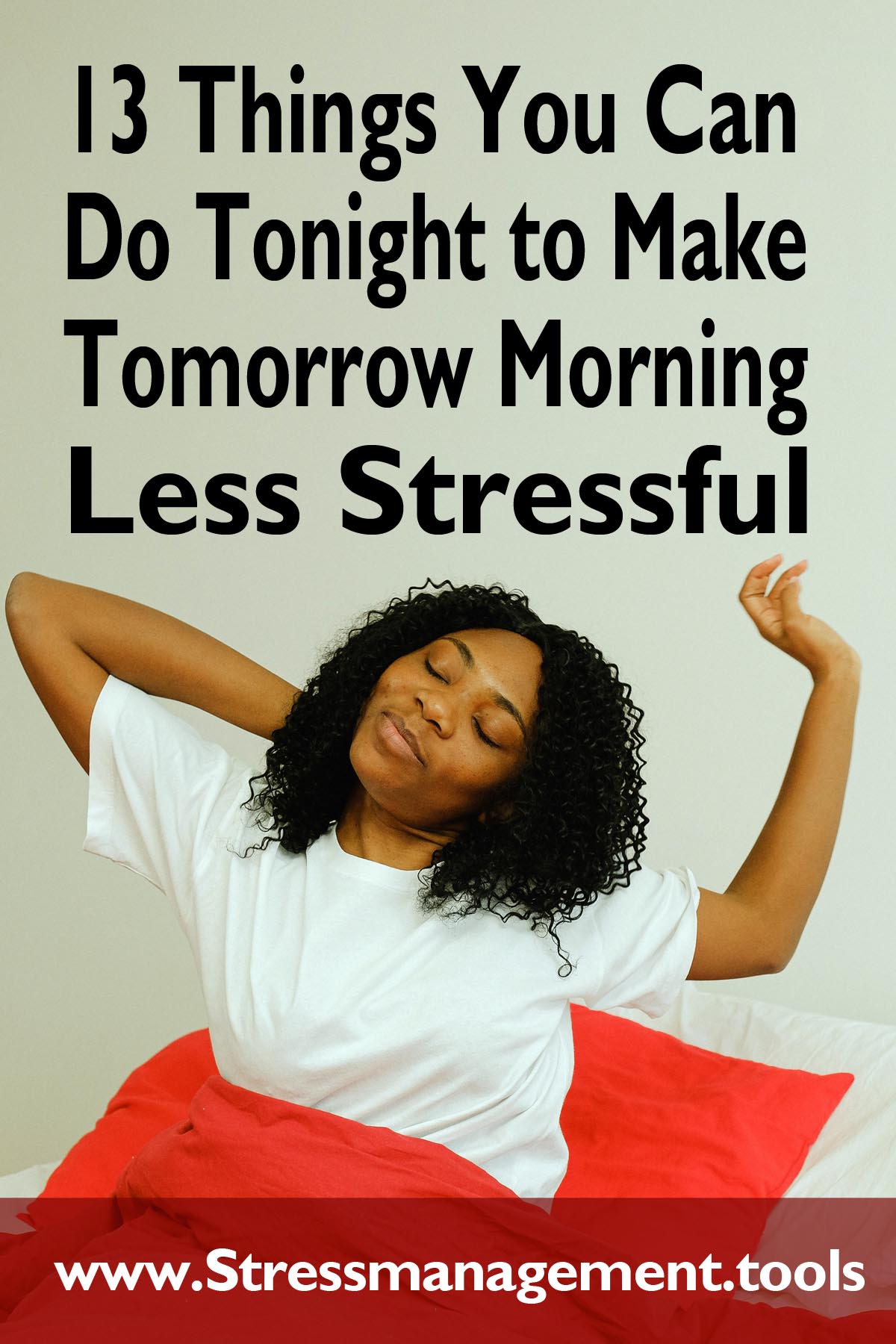
13 Things You Can Do Tonight to Make Tomorrow Morning Less Stressful

You can make your mornings run more smoothly. With just a bit of planning, you can have better control over the right start of your day. Take a look at these suggestions for feeling more relaxed as you start each day.

8 Ways to Save Time in the Morning

Staying on schedule is for many the biggest challenge. These time-savers will help you streamline your routine.

  1. Plan your schedule. Maybe you’re trying to cram too much into too little time. Figure out how much time you need for your usual activities. Then, you can calculate when you need to go to bed so you’ll get up in time and still be well rested each day.
  2. Organize your space. Do you know where your umbrella is? Keeping essential items in their habitual place will eliminate searching for car keys or gym bags. No need to search the entire house for each item. Put them always at the same place, and you will find them in an instant.
  3. Check the weather. Rain and snow may change your plans. Take a look at the forecast before you go to bed so you’ll be ready with rain boots or ice scrapers, and the proper clothing for each situation.
  4. Prepare breakfast. Eating breakfast gives you energy now, and makes it easier to resist snacking on junk food later. Assemble your cereal ingredients tonight so you can get going in an instant.
  5. Lay out your clothes. Hang tomorrow’s outfit at the front of your closet or on the back of your bedroom door. You already made up your mind on what you want to wear, so you just need to get dressed and get going.
  6. Simplify your look. How many products do you use in the morning? Design a simpler skin care regimen and browse around for a low-maintenance hairstyle. Saving some time will make you happier on the end of the day.
  7. Write notes. Save your brain power for more important subjects. Jot down reminders to pick up prescriptions or dry cleaning on your way to work. This way you free up your mind and nothing falls through the cracks.
  8. Shorten your commute. Studies show that the length of your commute has a dramatic effect on your health and wellbeing. Moving or changing jobs is a big decision, but you may want to explore your options. If you’re looking for a benchmark, the average one-way commute in the U.S. is 25.5 minutes.

Taking the train to commute to work

    5 Ways to Make Mornings More Peaceful

    However much you need to do, you can stay calm and focused. It’s a matter of attitude. These tips will help you enjoy mornings more.

    1. Adjust the light. Light has a powerful effect on your brain. Darkening your bedroom at night will help you to sleep better so you wake up feeling refreshed. The opposite holds true for waking up. Exposure to morning sun will banish grogginess.
    2. Skip the snooze button. Try placing your alarm clock across the room if you’re in the habit of hitting the snooze button. Those 10 minute fragments of sleep usually leave you feeling worse than if you get out of bed immediately. If you have troubles on getting out of bed, try a 5 second countdown and just launch yourself out of bed.
    3. Play music. Spend a moment before going to bet to cue up a playlist of your favorite songs. Lively music will give you energy if you’re dragging around. Gentle instrumental music will soothe your nerves if you’re apprehensive about a job interview or business presentation. Having the right music around will get you into proper mood.
    4. Download a podcast. Continue your education during your commute. Find a podcast that will teach you Roman history or the fundamentals of accounting. Or find some inspirational audiobooks. You will make better use of your time and arrive at work with an active mind.
    5. Connect with Your Creator. Take a moment each night to be grateful for your day, reflect on all the things that had happened, and thank God for your day. If there is anything to resolve, do that right at this moment. You will sleep better if you have peace of mind. At the morning when you wake up, take a moment to commit the day into God´s hand. Meditate on a bible verse and you will conduct your day with a different mindset.

    A few simple strategies can turn you into an early bird or at least make your initial hours happier and more productive. Starting the morning on a positive note will help you head off stress and feel calmer all day long. It will make quite a difference if you are off for the right start.

    Do you need a guide to help you understand how to cope with Stress in an all inclusive approach? Learn how to combat stress, mentally, physically, emotionally and strategically in your life.


    Get Me the Guide

    Filed Under: Planning, Time Management

    Utilize the Power of Prayer for Stress Relief

    February 12, 2023 by Martin Neumann

    Utilize the Power of Prayer for Stress Relief

    Stress is sometimes getting us unaware. We are suddenly facing a crisis and do not know how to handle it. Other times it will creep on us in small increments until we feel that life spins out of control. Stress will hit us harder when we are overtired, being sick or passing through tragedies. Few people think about prayer as a stress reliever when the schedule is tight. But a growing body of research shows that it could be a useful tool to get your stress under control.

    Utilize the Power of Prayer for Stress Relief

    Research on Stress and Spirituality

    The link between spirituality and health is starting to get the interest of several researchers. In the forefront is the research of Harald Koenig, MD, associate professor of medicine and psychiatry at Duke University, who surveyed more than a thousand studies showing the link between spirituality and health. In his book Handbook of Religion and Health he found that people attending church regularly have 1/3 of the time of hospitalization compared to the non-active group. He also found that religious people have 14 times higher chances to recover after heart surgery compared to the non-religious group. These are just some of the impressive findings of the relationship between spirituality and health.

    Dr. Roberta Lee speaks about the relation of prayer and stress relief in her book The Superstress Solution. She says: “Research shows that people who are more religious or spiritual use their spirituality to cope with life,… They’re better able to cope with stress, they heal faster from illness, and they experience increased benefits to their health and well-being. On an intellectual level, spirituality connects you to the world, which in turn enables you to stop trying to control things all by yourself. When you feel part of a greater whole, it’s easy to understand that you aren’t responsible for everything that happens in life.”

    Practice Stress Relief Prayer the Effective Way

    Not every prayer is equal. Some people just go through the motions without really feeling the liberating effects of genuine prayer. In order to be effective in lifting your load, there are some vital principles to include in your prayer experience.

    1. Recognize a Power Higher than You

    When you are in a tight spot, it is a liberating thought that there is a higher power taking care of you. Put things into the right perspective. Who are you in comparison to the universe? Do not think it is all your responsibility to save the world, because the world is much bigger than you can grasp. And don´t think your problems are the worst one within the universe either.

    When you do not find a way out, you need to trust that you have a heavenly father who is able to take care of you. Some people are believing this religion thing is just for emotionally weak people who need a crutch in order to get something they can hang on to. There are a lot of skeptical people out there. For me, it is as real as it can get. When you are sincerely interested in experience the presence of God, He will have a way to show you how He is acting in Your life. I have experienced it over and over. And it is very reassuring to know that there is somebody bigger than you, who is able to help you out when you are in a tight spot.

    A poor elderly woman praying

    2. Be Authentic

    When something is bothering you, it is not the moment to recall a prayer you have memorized as a child, or recite 10 times the Lord’s Prayer. It is the moment to speak to God as to a friend. Be honest about what is bothering you. And you do not need to wait for the right moment, present your request to God as soon as you feel a need. Be very specific about what is your problem, if you are formulating it into words, the undefined and abstract is becoming something concrete that you can put a handle on. The Christian Author Ellen White expresses it nicely in her book Steps to Christ:

    “Keep your wants, your joys, your sorrows, your cares, and your fears before God. You cannot burden Him; you cannot weary Him. He who numbers the hairs of your head is not indifferent to the wants of His children. “The Lord is very pitiful, and of tender mercy.” James 5:11. His heart of love is touched by our sorrows and even by our utterances of them. Take to Him everything that perplexes the mind. Nothing is too great for Him to bear, for He holds up worlds, He rules over all the affairs of the universe. Nothing that in any way concerns our peace is too small for Him to notice. There is no chapter in our experience too dark for Him to read; there is no perplexity too difficult for Him to unravel. No calamity can befall the least of His children, no anxiety harass the soul, no joy cheer, no sincere prayer escape the lips, of which our heavenly Father is unobservant, or in which He takes no immediate interest. “He healeth the broken in heart, and bindeth up their wounds.” Psalm 147:3. The relations between God and each soul are as distinct and full as though there were not another soul upon the earth to share His watchcare, not another soul for whom He gave His beloved Son.”

    E. G. White. Steps to Christ, p. 100

    3. Pray With and For Others

    Nobody is an island. If you can share your concerns with your friends then go for it. But instead of just be sorry and whine, use the moment to present your problems together with your friends to your Heavenly Father. Sometimes the faith of your friend can inspire you to take courage. It can relieve your stress if you can share your challenges and get some upbeat to put you on the right track.

    Some other times you can pray for some of your friends, neighbors or even strangers you meet at the road. Praying for the need of others makes you realize, that other people around you may face even larger challenges then you, and your problem may not be that big after all.

    4. Take Action

    By now you have identified your problem and you have submitted yourself to the care of God. You see some light at the end of the tunnel, you have hope to get your life under control, but there are things that still remain for you to do. Maybe you need some rest, take time to restore your body and mind. Get for real with a stress management plan. Get your priorities right, examine your diet and exercise plan. If you are working through some loss or tragedy, you may need to give you some time to heal and restore.

    There are moments we need to take action, and other moments where we need to be just quiet. Reinhold Niebuhr is expressing it quite on the spot in his famous Serenity Prayer:

    God, grant me the serenity to accept the things I cannot change,
    Courage to change the things I can,
    And wisdom to know the difference.

    A man at sunset sitting on a stone at a beach, expressing serenity

    Elements of a Prayer for Stress Relief

    You need no model or script to follow in your prayer life, like you do not need a script to have a chat with your friend. But there are some elements that can make your prayer experience more meaningful.

    1. Take time to talk openly about your life. Talk about the good, the bad, even the things you think are irrelevant to God. How are you talking to a friend? Are you worried that he is bored when you relate what is happening in your life? Probably not. So just take some time to be real.
    2. Analyze your actions. What did you do right, where did you fail? Where did you hurt somebody? What do you have to get straight? Confess your mistake and take responsibility for things you did the wrong way. Decide with whom you need to reconcile. And ask forgiveness for your wrong attitudes. In 1. John 1:9 we have the promise: “If we confess our sins, he is faithful and righteous to forgive us our sins, and to cleanse us from all unrighteousness.” You will feel a burden being taken off from your shoulders, and life will get so much easier.
    3. Surrender yourself to God. He is your Heavenly Father and will surely care for you. But sometimes His plans for you may be higher than yours. God says to you in Isaiah 55:9: “For as the heavens are higher than the earth, So are My ways higher than your ways, and My thoughts higher than your thoughts.” Trust that your Heavenly Father has the best intentions for you, and try to understand what He is trying to do in your life.
    4. Ask God for help. Be specific on what is going wrong and what you need. And when you have surrendered it to God, rest assured that He will take good care of you. Maybe the outcome is not always like you expected, but sometimes it is even better than you thought.
    5. Pray with Promises. The Bible is full of promises, and you can claim them within your prayer session. If you find a promise that applies to your situation, it is alright to claim it. If you are burdened with troubles, you can claim Mattew 11:28-30: “Come to me, all of you who are weary and carry heavy burdens, and I will give you rest. Take my yoke upon you. Let me teach you, because I am humble and gentle, and you will find rest for your souls. For my yoke fits perfectly, and the burden I give you is light.”. Or you may like to claim Psalms 4:8: “I will lie down in peace and sleep, for you alone, O LORD, will keep me safe.”
    6. Express your gratitude and praise. When we start to catalog the things we are thankful for, our list of challenges is less intimidating. It gets things into perspective. Life is not all bad, there are a lot of things to be thankful for. Look at the psalms. They are full of sincere talk with God, but they are also full of thanksgiving and praise. And it helps a lot to remember that God still cares for us. Remember how He has brought you through in the past, and you will gain courage to face the future.

    Now you have a number of tools to make your moments of prayer an opportunity to release stress from your lives. Once you apply them, you adapt those principles to make them something meaningful for yourself. It is good to create habits. Start out right in the morning, surrendering yourself and your plans in the hands of God. In the evening spend some special moments to reflect on the day, what was good and what needs to change. And whenever you face a problem, make it a habit to turn it over to somebody higher than you, so you have less on your plate to worry about.

    Do you need a guide to help you understand how to cope with Stress in an all inclusive approach? Learn how to combat stress, mentally, physically, emotionally and strategically in your life.
    Get Me the Guide

    Filed Under: Spirituality, Stress Management

    Reclaim Control in a Stressful World

    January 15, 2023 by Martin Neumann

    Ask anyone and they’ll probably tell you that their stress levels are at an all-time high. Brought on by global health issues, economic uncertainty, and dozens of personal issues, men, women and children are suffering from emotional turmoil that’s spiraling out of control.

    Reclaim Control in a Stressful World

    You don’t have to live like that anymore. It’s easy to get caught up in the barrage of stress coming at you from every angle. But if you want to take back control of your mental health and not be victimized by stress overload any longer, you can implement an action plan designed to get your life under control. Whether you’re worried about your finances, relationships, health concerns or other issues, the strategies you’ll find below will free you from the chains that are contributing to your unhappiness.

    You Are Not Alone – How Stress Is Weighing Us All Down

    Right now, especially since the pandemic hit, stress has negatively affected people in regards to being worried about health issues, the financial impact the pandemic and inflation has caused, and other issues that hit close to home.

    Recent polls are showing that stress is on the rise, and it is negatively influencing peoples’ behavior (such as making them snap in anger), causing tension in their body, and resulting in mood swings they don’t know how to manage.

    It’s not only what’s happening in the world right now, the uncertainty is also a big stress factor. Nagging questions about how things will turn out are a burden none of us should be carrying, but we are.

    As far as what’s causing all this stress, in the past three years, it was the pandemic, as most people reported. But the “future of the country” has also caused great concern. Job stress is a big one, and it’s no wonder with so many changes in the workplace due to the pandemic – not to mention paychecks not going as far as they once did.

    Other top stress issues are responsibilities you face as a spouse and parent as well as health issues you might be facing. And while older adults are suffering on a more regular basis, the younger generations are reporting extreme levels of stress.

    Women are saying they’re more stressed than men and married women have more stress than single women. Stress is affecting a large part of the population in a negative way, and detracts from our quality of life.

    How to Reduce Stress Over Money Issues

    Finances are one of the most common stress factors in many individual’s lives, and it is not limited only to the poor. Even the wealthy can be suffering financial stress from poor decisions, the stock market, inflation, job loss and other situations that can wipe out someone’s financial security in an instant.

    Your money stress may stem from simply not earning enough to pay your bills or afford groceries. When you pair this with soaring inflation, it can be a recipe for disaster when it comes to your mental health.

    It’s natural for financial stress to emerge from time to time. But if you are feeling on edge 24/7 from money woes, you need to dig yourself out of that hole and take care of the situation so that your emotional needs are met.

    One thing that will help you reduce stress over your finances is to know exactly where you stand. If you are no longer opening your bills or have not looked at your credit score, it can be worse than if you had the facts laid out in front of you.

    Doing accounting to find out the current financial situation

    You can start a spreadsheet that tracks exactly what your income is, and also all of your monthly expenses as well as debt that you have incurred. It may be a little unsettling to initially see the numbers in front of you.

    But once you know where you are standing, it will be easier for you to create a plan to become financially resilient once again. The best way to ease stress over finances is to start cutting back on careless spending.

    You will feel more guilt when you are looking at the money you need if you know you have spent it on things that shouldn’t even be in your budget, like a daily coffee at Starbucks.

    Even though something like this isn’t a lot of money, it can add up. Even if you only bought a small coffee every day, that would be almost $100 you would be spending just on a single beverage each month.

    The next thing you want to do when it comes to achieving peace of mind with your finances is to reach out and contact those companies that you owe money to and see what arrangements can be made to lessen your burden.

    Some companies will waive penalties or change the due date for you if it will help you keep your head above water. You want to make a plan to pay off your highest interest rate debt first.

    Then, find ways to earn extra money. You might sell things that you have lying around the house that you no longer use on sites like Facebook Marketplace, Craigslist, or eBay.

    Another thing you can do is get a side hustle such as delivering food from restaurants or grocery stores, or using your car for rideshare purposes working for companies like Uber or Lyft.

    If you can’t be out of the house after your normal working hours, you can even start a business online as a freelance service provider or as an online entrepreneur who makes money by sharing good advice on a topic of your expertise.

    What to If You’re Still Suffering from Pandemic Stress?

    There has been a lot of fear mongering that has occurred over the past two to three years. The pandemic led people to spread misinformation from all sides, to attack one another, and to heighten their fears even if they were unfounded.

    This was a health issue, but it was turned political in the process, which added even more stress to peoples’ daily lives. The stress wasn’t just about health, even though initially everyone was concerned about whether or not they would get sick or even die if they caught the coronavirus.

    In the beginning stages of the pandemic, you couldn’t even get groceries without whipping out a package of disinfecting wipes and carefully cleaning every item in the bags.

    Some people were masked up and some were not. Some had vaccines and others did not. Instead of everyone living their life by their own rules, which Americans have always done, you may have had to deal with people who thought differently from you confronting you about your decisions. In fact, this type of behavior still exists in some places. The fear was based on the uncertainty of what impact the unknown virus would have.

    A group of people improvising on masks

    However, stress from the pandemic was more than just health related. Many people experienced stress from the isolation that they felt. Whether or not your city or state had a mandatory lockdown, many people stayed home just to be on the safe side.

    The isolation and loneliness that many people felt no longer socializing in public took a toll on our society. From school kids who no longer had friends to interact with, to elderly individuals who were left to fend for themselves without family to visit them, there were very few people who were unaffected by these decisions.

    Another toll that was due to the pandemic is the job stress that many have to endure. Some companies were able to morph into a telecommuting situation where you were able to work from home and continue earning a paycheck.

    Other companies simply had to lay off most of their staff, and you were suddenly without a steady paycheck and had to rely on government assistance. Those that were left on the job, had to work overtime to keep everything afloat. If you were a business owner, you may have lost everything that you have worked for, which is a very stressful and heartbreaking situation.

    Most people have either gone back to work or started their own business at this time, but you may still have some lingering social anxiety or health concerns that you would like to manage better.

    It may help you to stay informed on ways you can protect yourself. You need to focus only on what you can control for your own life and not stress yourself out about what others are doing or not doing.

    It’s one thing to stay informed and another to obsess about the pandemic. You don’t want to let it consume your life on a daily basis. Keep in mind that it’s the media’s job to inflate fear so that you will click through on their links and stay tuned to their channel, so even if the information is accurate that they are reporting, you can’t rely on it to convey the correct level of alarm.

    Do World News Keep You on Edge?

    News of global catastrophes have never hit us this hard before. Previously, you might hear a segment on the 5 o’clock news or keep up with the world with the Sunday newspaper. But now, global news is being shoved down your throat 24/7 on every channel and website you visit.

    It’s no wonder we’re stressed! Never before have you had to hear about every country’s war, famine, crime and political chaos on a daily, if not hourly basis. And the media know that it’s going to get views and clicks if they make it sound as dire as possible.

    A man with a startled look examining news on a website

    Whether it’s a war brewing in a far off nation or a political climate that’s teetering on the brink of instability, you don’t need to be tuned in to this day in, day out. Unless you are in immediate danger, it isn’t necessary to sabotage your mental health like this.

    Drought, political decisions, plants that are shut down – ask yourself if it’s affecting you right now, or if it will be something sabotaging your daily life in the near future. If not, shelve your worry until a later date and see if it gets worked out.

    There’s a reason why stress levels tend to decrease as we age. While Gen Z is highly stressed right now, older Americans are less so. Experience tells us that things we used to panic about eventually have a way of working themselves out – and it is of no use to fret about things that likely won’t materialize or can’t be controlled.

    Managing the Many Personal Stress Issues in Your Life

    Part of your stress might be more personal and less global or newsworthy. Everyone goes through ups and downs in life. You will – at some point – have to weather the storm or become a victim to it.

    There may have been relationship woes in your life recently – a breakup with your significant other who you hoped to spend an eternity with. Recently, the pandemic affected these unions in a horrible way – maybe because people were locked down together, experiencing their own stress over money and health, and took it out on each other.

    You might want to work on the relationship to see if it can be salvaged now that things are going back to normal. If things can be repaired, it is normally better for everybody involved. 

    If your relationship ends, give yourself permission to grieve, but let go of the hatred and stress it brings thinking about what went wrong. You don’t want to keep one foot in the past as you try to move forward and find your own happiness.

    Sometimes, you might be dealing with the stress of parenting. Parenting stress never ends. As a new parent, you stress about not knowing what you’re doing. When they’re toddlers, your stress is about everything they get into when you’re not looking for a moment.

    A couple taking care of their kids

    Later on you’ll have to deal with stress about schoolwork, chores, protecting your child from bullies and heartache – their health and more. Even once they leave the nest, your stress will be about their happiness and if they’re sad, you’ll be sad.

    Being a parent is stressful, but in order to give your child the best life possible, you have to teach them how to be resilient in spite of what’s happening around them. The best way to do this is to lead by example.

    Another stress you might be experiencing is your job. Maybe you don’t have one and are having trouble finding one. You might have to take the stress away by increasing your skills or taking something temporarily to take the financial pressure off until you find the perfect position.

    Or maybe you’re employed, but unhappy at your job. If this is the case, don’t sit around stewing about your situation – make a plan to take action! You might be able to level up within the company to a better position, or find a different company or even career to pursue that will make you happier.

    There are times when our personal stress is more heartbreaking. A death in the family can cause grief that’s overwhelming. Only time can ease the pain, but you can choose to focus on appreciation for having had that person in your life.

    If you’re a caregiver of a disabled or special needs child or adult, it can put a physical and mental strain on you. Make sure that, in order to stress less, you give yourself some time away from your duties to relax and recharge.

    There are home health aids who can step in and provide relief for you so that you can go to the spa or visit the beach and soak up the sun. Don’t feel guilty about this – because what you’re doing will allow you to be your best self for the one you’re taking care of.

    Don’t Self-Soothe with Dangerous Vices

    When you’re looking for stress relief, you might inadvertently turn to things that can ultimately do more harm than good. Initially, they may take the edge off and make you feel better – but over time, they can have very damaging effects.

    For example, regardless of what is at the root of your stress, you might find yourself drinking a little more alcohol than you used to. It might start with one drink after a rare hard day at work, only to evolve into three or more drink on a regular basis.

    A drunk man in the couch of his living room

    Some people abuse their prescription pills, too. A doctor may have prescribed muscle relaxants or sleeping pills and now the person gets hooked on them just to avoid having to think about all of the stress swirling around in their head.

    Non legal drugs might also become an issue. From marijuana to heroin and everything in between, there are some people who get drawn to this lifestyle as a way to escape the pain and stress they are plagued by.

    Smoking (or vaping) might be something you start doing on breaks at work or at other times to relax your mind. Then one day you find that nicotine is in control and you no longer have a choice about using it.

    Or you might be someone who turns to food to suppress your anxiety. Emotional eating is a big problem for both men and women, and it can turn into something that damages your health over time.

    People reported gaining a lot of weight during the lockdown of the pandemic. It was stressful, and instead of going out, they would order food and grocery deliveries and binge eat since they were no longer working or socializing on the go.

    Even sitting and binging on videos and shows can harm you if that’s what you choose to use to veg out and forget about your worries. Many people are now suffering from sitting disease, which is a term that describes how many health issues stem from the habit of not moving very much and sitting excessively.

    And of course, your vice may not be a habit like food, alcohol or drugs, either. You might get in the habit of taking your pain out on others. You may not mean to at first, but snapping at loved ones or strangers can help you let off steam for a second, but do more harm than good.

    There are even people who trauma dump on others – unloading all of their stress on their spouse, friends, family, and even people they don’t know online. Make sure you’re working with a therapist or even using self-taught methods to alleviate your stress without adopting any of these vices that can ruin your reputation and relationships and cause you more mental or physical harm.

    Trade in Your Social Media Addiction for Calming Activities

    If you poll younger generations, they’ll tell you that they belong to a number of different social networking sites and apps. They’ll also tell you that social media is one of the main sources of their stress.

    You might have formed this addiction yourself. It’s tempting to avoid work or other demands to scroll on Facebook or TikTok for a few minutes. But these minutes end up turning into hours each week.

    This can be very damaging to your psyche. Now some people will say that there is a lot of positive out social media. This is true. Social media can provide a way for people to socialize without having to get out of the house and there is a lot of positive content to be found on social media.

    However, while you are trying to find the nuggets of positivity, you will inevitably encounter negative and harmful content that you are actively exposing yourself to on a daily basis.

    Social media can be used to learn new things – like how to cook a certain meal or how to start a garden. But if you just let anything and everything into your feed, you will see all kinds of harmful influences.

    You have to make sure you’re weeding out accounts that bring stress into your life. If you train the algorithm of the platforms you are using by engaging in content that lifts you up and hiding the content (or blocking the accounts) that cause you stress, they will provide more of what you want and less of what you don’t.

    There are a lot of people trauma dumping on social media, too. And now it’s not just them telling their stories. You might be scrolling on TikTok and see an entire series posted of a woman who secretly recorded her husband being extremely abusive to her.

    This is traumatic to witness and can cause your Cortisol to spiral out of control. Instead of gawking at the videos and immersing yourself in other peoples’ problems, take back control and shut that kind of content out so that you’re being lifted up when you use these tools.

    You may also want to put some parameters about how often you are using social media. Sometimes, people can get hooked on these sites and platforms and spend hours each day on them.

    Teenagers with cell phone addiction - Photo by cottonbro from Pexels

    You want to be living life in the real world, and if it takes a digital detox to help you wean off of these sites and apps, you might want to take that approach so that you are able to find joy with those around you and in your home and work life.

    Build a Stress-Relieving Routine You Can Rely On

    One thing you can do to reclaim your life from stress is develop a routine that ensures you are getting stress relieving properties every single day. From the time you wake up until the time your head hits the pillow each night, you want to be engaging in self-care.

    If you are the kind of person who spends all morning rushing around in a panic to get out the door, get yourself on a better sleep schedule so that you have plenty of time to wake up relaxed, eat a nutritious breakfast, and start your day off on a positive note.

    There are physical things that you can do to alleviate stress. For example, you can engage in deep breathing techniques anywhere at any time to instantly calm your nerves.

    In the evening after work, you may want to put on a soothing face mask and take a nice warm bath with some Epsom salts and a candle lit nearby with your favorite scent emanating from it.

    A woman taking a relaxing bath

    A routine that includes exercise is always beneficial in helping alleviate stress and empowering you throughout your day. Not only does this contribute to your physical health, but it also gives you a boost of endorphins that can benefit you emotionally, too.

    If you have trouble sleeping at night, make sure you are setting yourself up on a proper sleep hygiene routine. This can include dimming the lights a bit and reading before bed rather than being on your phone or iPad.

    If you have the opportunity, timewise, you may want to also integrate some of your favorite activities into your routine. These may not be daily, but you may be able to do things like volunteer with animals, play golf or go to the spa once or twice per month.

    Another part of your stress relieving routine will be to make sure you are spending time with people who bring joy to your life. That may simply be your spouse and children or it may extend beyond that and include friends and additional family members.

    Prevent Future Stress by Preparing Early and Being Aware

    Sometimes, there are situations where the stress is unavoidable. You know it’s bound to happen, and instead of preparing for it, you simply brace yourself for the unknown. Instead of walking on eggshells or living your life in a heightened state of anxiety, you can alleviate a lot of that stress simply by being prepared and staying aware.

    For example, if the news is something that frequently causes you concern because you are watching stories about a broken supply chain or threats of war being waged against your country, you can begin a sensible survival prepping plan that gives you peace of mind that you will be okay in a worst case scenario.

    You can do this with anything that brings you stress. For example, if you know you will be stressed out at the beginning of school trying to get your kids back in a routine, start a couple of weeks early and have everything planned so that they can assist you with making their lunches and choosing their clothes the night before.

    You have to walk a fine line between staying informed and becoming obsessed. It’s never a good idea to stick your head in the sand and ignore everything that’s going on in the world.

    However, it’s also not smart to take the opposite approach and stay glued to mainstream media 24/7 so that they can feed you a diet of fear and anxiety. You are in control of what you allow yourself to be exposed to and how you react to it.

    The key is to sit with yourself each night or at least once a week and ask yourself what it is that is causing you stress and see if it can be mitigated so that it doesn’t have power over you from that point on.

    Stress has become a pandemic of its own in this world. Many people will succumb to it and live a life of depression and anxiety. You don’t have to be chained to an overload of stress if you’re willing to take steps to prevent and manage it in your life.

    Do you need a guide to help you understand how to cope with Stress in an all inclusive approach? Learn how to combat stress, mentally, physically, emotionally and strategically in your life.

    Get Me the Guide

    Filed Under: Stress Management

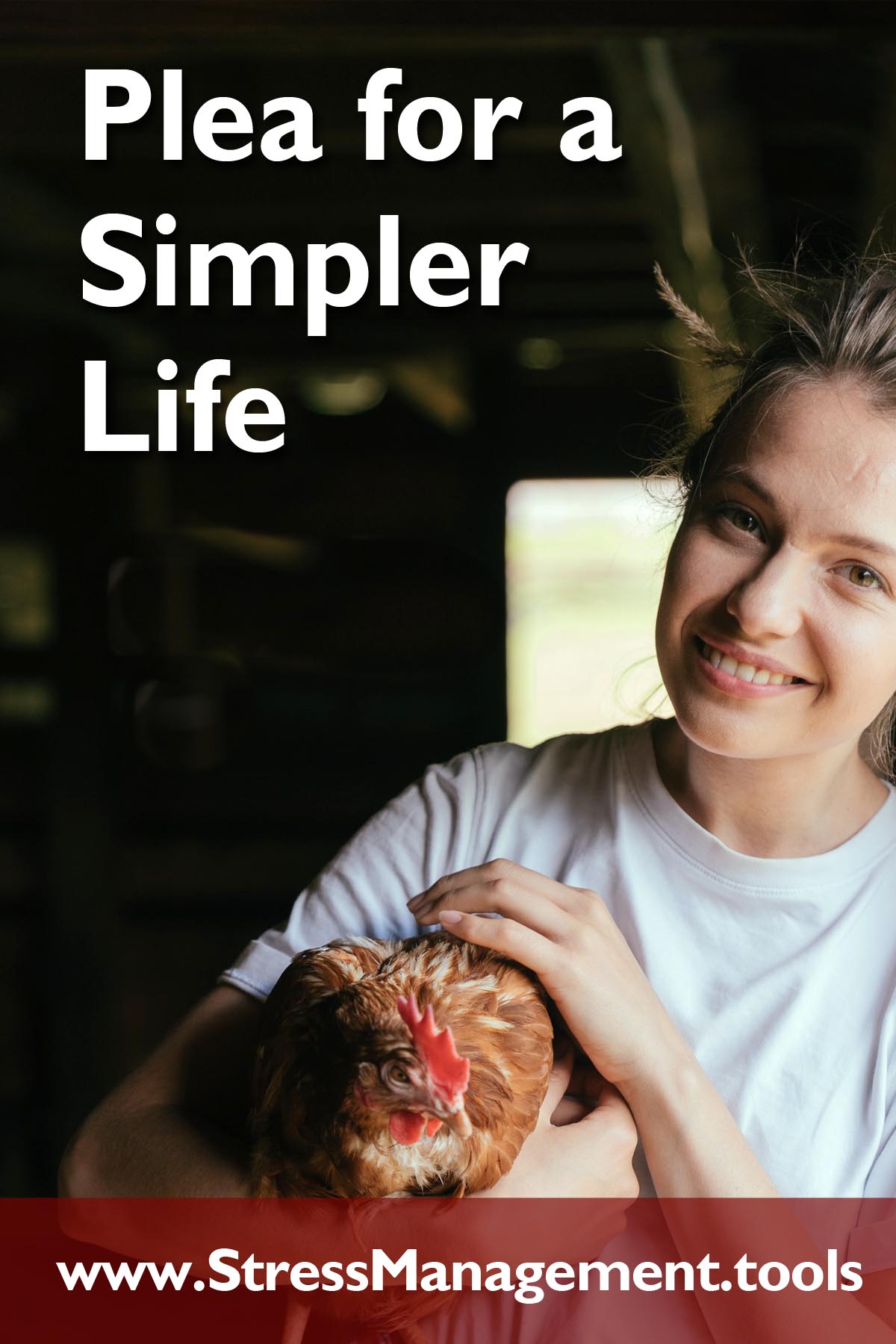
    Plea for a Simpler Life – Less is More

    December 11, 2022 by Esther Neumann

    If my grandfather, born in 1890, were to come into my house, he would not find his way around, neither in my household nor in my office. Our present generation has so many more opportunities to shape our working world and our private lives. But life has also gotten more complicated. We need to be familiar with so many modern communication tools. So many machines and gadgets with complex procedures that we can’t figure out, do the heavy, tedious work for us. Actually, these modern technical achievements are supposed to give us more time for ourselves.

    Plea for a Simpler Life – Less is More

    When I’ve finished writing this article, I won’t have to write it clean on paper, put it in an envelope and take it to the post office for my editor-in-chief. I remain seated in my office chair and send it via the Internet. If the editor wants to, he can open and read it on his computer a few minutes later.

    What do I do with the time I’ve saved? Am I going to fold my arms, be happy about the successful article, and reflect on the essentials? I have to watch over my time, my health, my thoughts. I don’t want to plunge into the next activity like the fast swimmer with a head dive into the cold water.

    I want to take the liberty – and fortunately I can afford it – to structure my working hours for myself. Instead of getting dragged by the daily grind, I want to consciously take responsibility for my everyday life. After a few hours at the computer, it’s time to do some gardening or kitchen work. Every now and then a nature walk is allowed. During this time, I come up with all sorts of things.

    Sowing seeds in the garden

    Most people live outside of their “assets”. It’s not just about money, about consumption, but also about time, about food, about relaxation. It’s not about asceticism, but about simply doing without the superfluous, which we find difficult to deal with anyway.

    Too many pounds make me short of breath. Why did I eat so much again? I have been wanting to lose a few pounds for a long time! Yes, I can afford a pumpkin pie with whipped cream every now and then. Tomorrow, however, there will be an apple for dessert – and I’ll simply enjoy it! Actually, a fruit day every now and then is good for my health. Or should I try just drinking tea for a whole day? That’s definitely good for me and I’m happy when I’ve grown beyond myself and my appetite.

    While I’m tidying up, I can go through my closet. What has accumulated there, such an abundance! I haven’t worn this lovely piece in a year. That’s why my friend recently said to me: “I always see you in the same sweater.” Both pieces are still in good condition: so wash one of them and off it goes to the thrift store. There’s still enough in the closet.

    A man struggles with a pile of clothes

    What else can I get rid of in order to live a simpler life? How was it last night before falling asleep? I was worried and anxious about the future. The car is getting in his years, the roof of the house would need some repairs. The winter is still long and the wood supplies are running out. All this costs money. Where does it come from? How am I going to do this? Then even the past came into play. Do you still remember the mistake you made back then? You really weren’t fair to your child. Hopefully it hasn’t been hurt and is getting over that.

    Fears and worries about the future, lingering in the past are robbing me the strength and time to simply live in the now. And I can only live in the now. Have I ever experienced anything in the past or done anything in the future? The answer is simple: I live in the now. I can cope with today, this attitude gives me strength, but today I don´t get what I need for tomorrow.

    So I can also simplify my thoughts, I can remove the superfluous. Simply by not brooding too much over things I can’t change; but also, simply by looking forward to the new day every morning, to the sun that will rise again, even if the weather should remain cloudy, it’s still there. For me, every new day is an invitation to simply live – or live simply – simply in both senses.

    It’s up to me to shape my day to be simpler, to find joy in the simple things of everyday life, in the opening of a flower, in the laughter of a child, in the surprised expression on my work colleague’s face when I have greeted him with enthusiasm and wished him a very good day.

    An opening flower

    No amount of possessions can buy me the joy of life. Proverbs 13:7 says, “There is one who makes himself rich, yet has nothing; And one who makes himself poor, yet has great riches.” If I give in to every wish and fulfill it, then I cannot be happy in the long run. Neither money nor confirmation, not even success can still my longing for a fulfilling life. True joy comes from living a simple life, enjoying nature, being accepted by my circle of friends and feeling safe with my God, Creator and Sustainer.

    Do you need a guide to help you understand how to cope with Stress in an all inclusive approach? Learn how to combat stress, mentally, physically, emotionally and strategically in your life.

    Get Me the Guide

    Filed Under: Planning, Simplifying

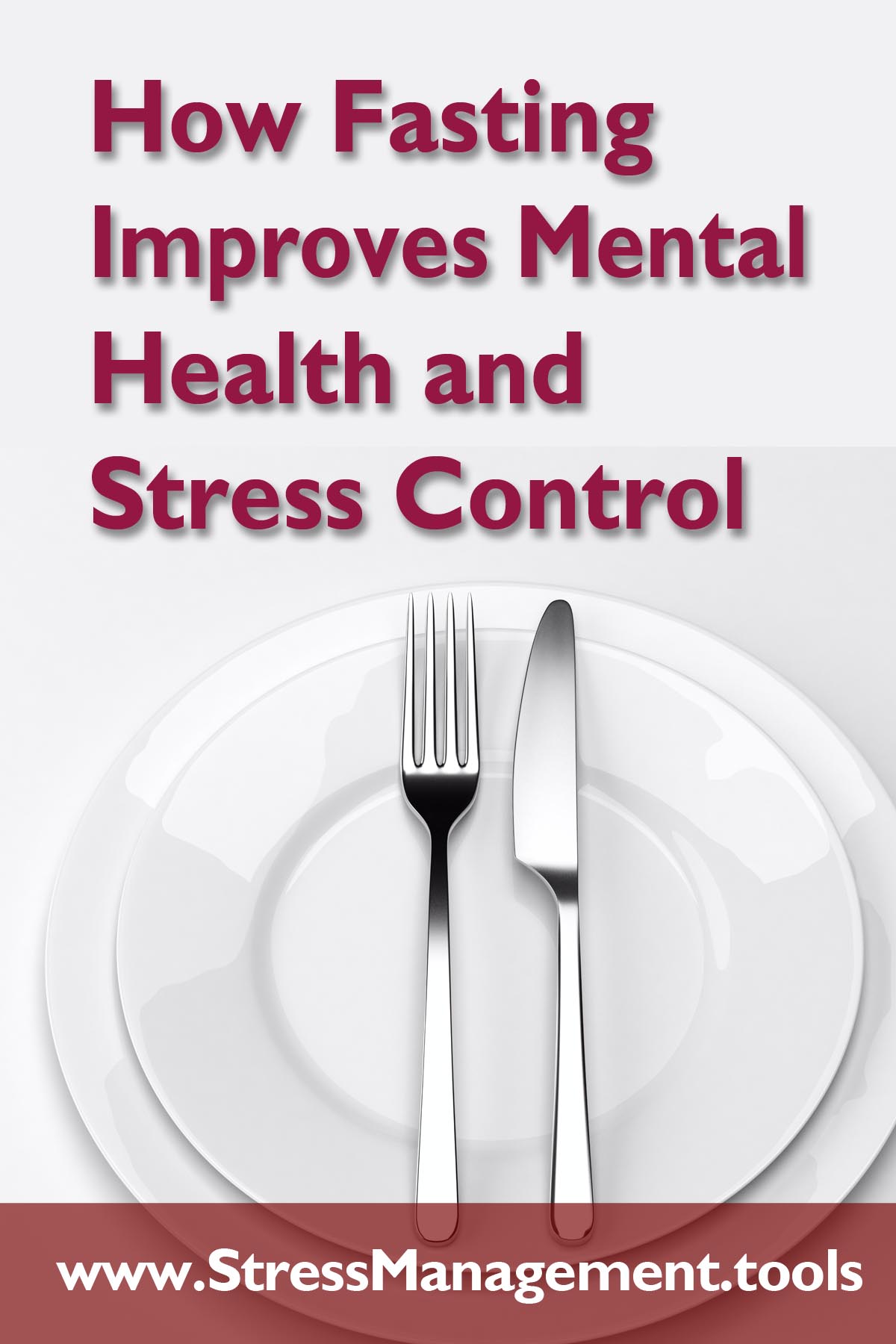
    How Fasting Improves Mental Health and Stress Control

    November 13, 2022 by Martin Neumann

    Fasting Improves Stress Control

    There are many different motives why people choose to do fasting. Some will do it to lose weight, others to clean the body, and often it is done for religious purposes. While all of that can be achieved when done properly, many do not realize that fasting has a positive effect on our mental health and stress control.

    How Fasting Improves Mental Health and Stress Control

    What is Fasting?

    Fasting is a routine whereby you decide not to eat food for a certain time. Several metabolic adjustments occur during fasting. Some forms of fast restrict even liquid intake, which can get detrimental to the health very quickly. A fast for health reason is often done in the form of intermittent fasting, where food intake is alternated with a few hours of fasting.

    Skipping food for some hours can help increase the level of ketones in your body. They are produced when energy from carbohydrates is used up and the liver depends on breaking down fat to supply energy in form of ketones. They are not only influencing health and aging, but are also beneficial in improving brain health. However, fasting offers still some more advantages. It has a great benefit to our mental health in a way that is not well known by many people.

    Common Types of Fasting

    Before we go into full detail about how fasting helps mental health, it is important to state the different types of fasting. The most common types of fasting are:

    16/8 fasting: 16/8 fasting is very common and is all about fasting and eating intermittently. Every day you eat within an allowed period of eight hours, after which you will fast for the next 16 hours.

    5:2 Approach: The 5:2 approach is about eating regularly five days every week. For 2 days of the week (not in a row), you would then limit your food to a single very light meal of about 500-600 calories.

    Alternate-Day Fasting: That is the toughest form of intermittent fasting, where you alternate between days where you eat what you want and days where you eat nothing at all. It can lead to weight loss and improved health, but it is hard to stick to this protocol for the long run.

    Intermittent Fasting Concept

    The Dangers of Improper Fasting

    Fasting is fine when done correctly, but if done in the wrong way, it can do more harm than good. If we go into long fasting periods, metabolism will slow down and make it more difficult to shed those extra pounds in the long run. Pregnant women, breastfeeding mothers, children and very frail people should be more cautious with fasting, and diabetics should be closely monitored to avoid complications. It is important to learn how to fast correctly in order to reap the maximum benefits.

    Fasting to Help Increase Your Mental Health

    Fasting can be used to increase your mental health in various ways. From improving brain function to reversing mild cognitive impairments in older people, fasting has several benefits to mental health.

    Here are 6 ways fasting can improve your mental health:

    Enhances mental functioning: Each time we fast, our bodies have fewer toxic materials passing through the lymphatic and blood systems. This way, we can think clearly. During fasting, the energy which the body usually uses for food digestion will then be used by the brain. Initially, you will not be able to detect any change until a few days into the fasting. This is because the body usually takes some time to adjust to the new routine. Also, when you first begin fasting, you may suffer headaches or other pains. But as soon as the body adapts to the new routine, your brain will begin functioning optimally. This will result in better memory, clearer thoughts, and enhanced functioning of other body senses.

    Improves brain function among older adults: Fasting can improve specific parts of brain function as people grow older. This works especially with mild cognitive impairment, which is usually associated with seniors as this is a phase they experience before dementia. It can cause problems with thinking or memory and is reversible. Clinical studies have confirmed that mild cognitive impairment can be reversed with fasting.

    A smart elderly person working on a computer

    Empowers the brain: Fasting can lead to a short-term restriction on calories. This can help the brain produce more anti-depressant chemicals. Since fasting causes the body to produce ketones from available fats, our brains use this as fuel. With the brain being boosted by ketones, intermittent fasting can be used to treat the symptoms of Alzheimer’s disease, Parkinson’s disease, as well as many other neurodegenerative diseases.

    Helps with autophagy: Fasting is also important to mental health due to its ability to trigger autophagy. This is a necessary process whereby the brain cleanses itself from all the trash it accumulates during the day. Autophagy is a process of self-cleaning whereby the all cells of the body, including the brain are cleaning themselves and get rid of old debris and damaged cells. Autophagy is a process that happens efficiently after a fasting period of 16-20 hours, which is easily achieved with intermittent fasting. It helps the brain to create healthier and newer cells.

    Improve your memory: It has been proven clinically that our memory is improved significantly when we restrict the hours we eat. Some studies have shown that intermittent fasting can help improve memory in humans.

    Reduce stress and anxiety: Fasting has been proven to help improve issues of mental health, which include depression, anxiety, and stress. A recent study conducted was able to prove that people who fasted during a certain period like Ramadan showed improvements in anxiety, stress, as well as symptoms of depression. Any kind of intermittent fasting will give you this benefit. The study revealed that the depression and anxiety levels of the participants went down after intermittent fasting.

    Conclusion

    Intermittent fasting is good for our health, increases longevity and is beneficial for our brain. When we are stressed, we should think more often about intermittent fasting as a way to deal with the challenges in a more efficient way. It is easy to implement and can give you a long-lasting benefit in your stress control. With that many benefits, what are you waiting for?

    Do you need a guide to help you understand how to cope with Stress in an all inclusive approach? Learn how to combat stress, mentally, physically, emotionally and strategically in your life.
    Get Me the Guide

    Filed Under: Healthy Lifestyle, Nutrition Tagged With: Intermittent Fasting

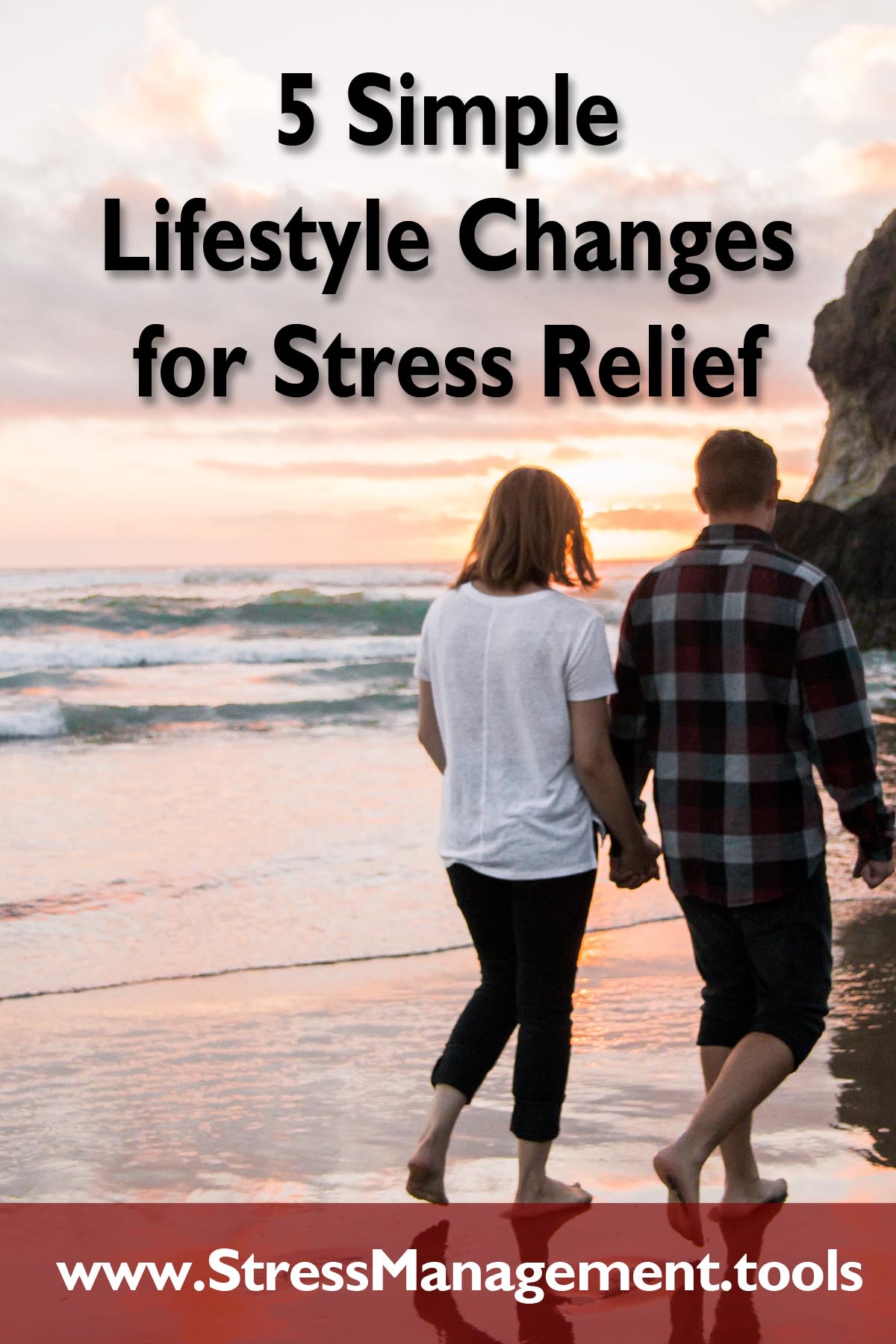
    5 Simple Lifestyle Changes for Stress Relief

    October 16, 2022 by Martin Neumann

    Lifestyle Changes for Stress Relief

    Did you know that around 74% of people said in a recent study, that they’ve felt so stressed that they’ve been unable to cope?((Results of the Mental Health Foundation’s 2018 study. https://www.mentalhealth.org.uk/explore-mental-health/mental-health-statistics/stress-statistics)) You may not be at that point quite yet, but it’s worth making some simple lifestyle changes to reduce your stress levels before you get there.

    5 Simple Lifestyle Changes for Stress Relief

    The good news is that there are ways you can cut back on feelings of stress each day, from the comfort of your own home. Here are some of the top tips.

    Exercise

    Exercise is the number one way to handle stress.

    When you’re feeling overwhelmed, you might not fancy rushing out to the gym for a sweat session. However, exercise is an amazing way to get endorphins – and positive feelings – rushing through your body. People who exercise regularly are less likely to suffer from anxiety than their counterparts.((M.H.M. De Moor, et.al. Regular exercise, anxiety, depression and personality: A population-based study. Preventive Medicine, Volume 42, Issue 4, 2006,Pages 273-279
    https://doi.org/10.1016/j.ypmed.2005.12.002))

    When you exercise – even only a little – you reduce the amount of stress hormones in your body and replace them with handy endorphins, which help to boost your mood.

    Exercise can also improve sleep quality, which is often negatively affected by anxiety and stress. When you get enough sleep, you’re more capable of dealing with stressful feelings.

    To get the most out of your exercise routine, find an activity you enjoy and mix it in with your schedule – even if it’s just a stretching session each night.

    Get Social

    Do you ever get the urge to isolate yourself when you’re stressed or nervous? You’re not alone. However, withdrawing from your social group could make your stress worse. Being part of a group of people who love and care for you will help to get you through tough times.

    One study found that spending time with friends helps to release the natural stress reliever – oxytocin. Some professionals even call the socializing response the “tend and befriend” approach, rather than the “fight or flight” that we’re used to with stress.((Taylor SE, et.al. Biobehavioral responses to stress in females: tend-and-befriend, not fight-or-flight. Psychol Rev. 2000 Jul;107(3):411-29. doi: 10.1037/0033-295x.107.3.411))

    If you can’t meet with someone face to face, find another way to connect. You can call a friend or loved one to vent some of the things you’re stressed about. Get into a video meeting, or just send someone a text if it helps.

    Make Yourself Laugh

    Have you ever noticed that it’s difficult to keep focusing on the things that make you feel anxious or stressed when you’re laughing? Laughter is genuinely good for your health, both from a physical and a mental perspective. It helps to relieve tension in your muscles and decreases your stress response.

    A group of friends laughing.

    Over time, regular periods of laughter can improve your mood and help your immune system to work better. According to a study of people suffering with cancer, people who laughed most experienced more stress relief than those who just distracted themselves.((Bennett MP, Zeller JM, Rosenberg L, McCann J. The effect of mirthful laughter on stress and natural killer cell activity. Altern Ther Health Med. 2003 Mar-Apr;9(2):38-45. PMID: 12652882.))

    Read a funny book or talk to a friend who frequently makes you laugh. Being able to laugh about your own mistakes can be very much relieving stress. Even if you’re just giggling at something on TV, let it out.

    Practice Self-Care Activities

    We could all benefit from investing more time and effort into ourselves. We live in a society where it’s increasingly common for people to prioritize working too much or barely getting any sleep. However, these are the kinds of things that increase your stress.

    Sometimes, it’s important to look at your life and ask yourself what you need to feel better. That could mean taking the time that you need for yourself and saying “no” when others ask you for help. It’s not selfish if you have reached your limits – it’s about giving yourself the help you need first.

    Good self-care could also mean changing your routine. Go to bed earlier or change your menus so that you’re eating healthier food. Invest time and energy into things that make you feel good – even if it’s just having a long bubble bath.

    Try Something New

    Finally, sometimes all you need to get rid of stress is a new passion.

    With that in mind, why not try something new? Take an art class with a pal and see whether being creative each day could help you to eliminate anxiety.There are plenty of studies that indicate that creative activities can reduce your anxiety levels.

    If art isn’t your thing, try learning how to cook. Taking a class that teaches you how to create delicious and nutritious meals is an excellent way to get a new hobby going. When you’re cooking, you’ll be focused on what you’re doing in the kitchen, rather than spending all of your energy worrying about the things that bother you. Plus, learning how to cook could help you to eat healthier too!

    Maybe you want to volunteer in a local organization in order to see the satisfaction in the faces of those you have helped. It can be very much rewarding and take away your focus from the worries of everyday life. Plus when you are in touch with people who are much worse off than you, then your struggles do not seem so big after all.

    Try one of these effective strategies the next time you’re feeling stressed. Get in the habit of using them regularly and you’ll find greater enjoyment in your daily life. And get the 10 Minute Guide to Stress Management in order to get a clear plan on how you can control your Stress.

    Do you need a guide to help you understand how to cope with Stress in an all inclusive approach? Learn how to combat stress, mentally, physically, emotionally and strategically in your life.

    Get Me the Guide

    Filed Under: Healthy Lifestyle

    « Previous Page
    Next Page »

    Primary Sidebar

    Copyright © 2026 Stress Management Tools · Log in